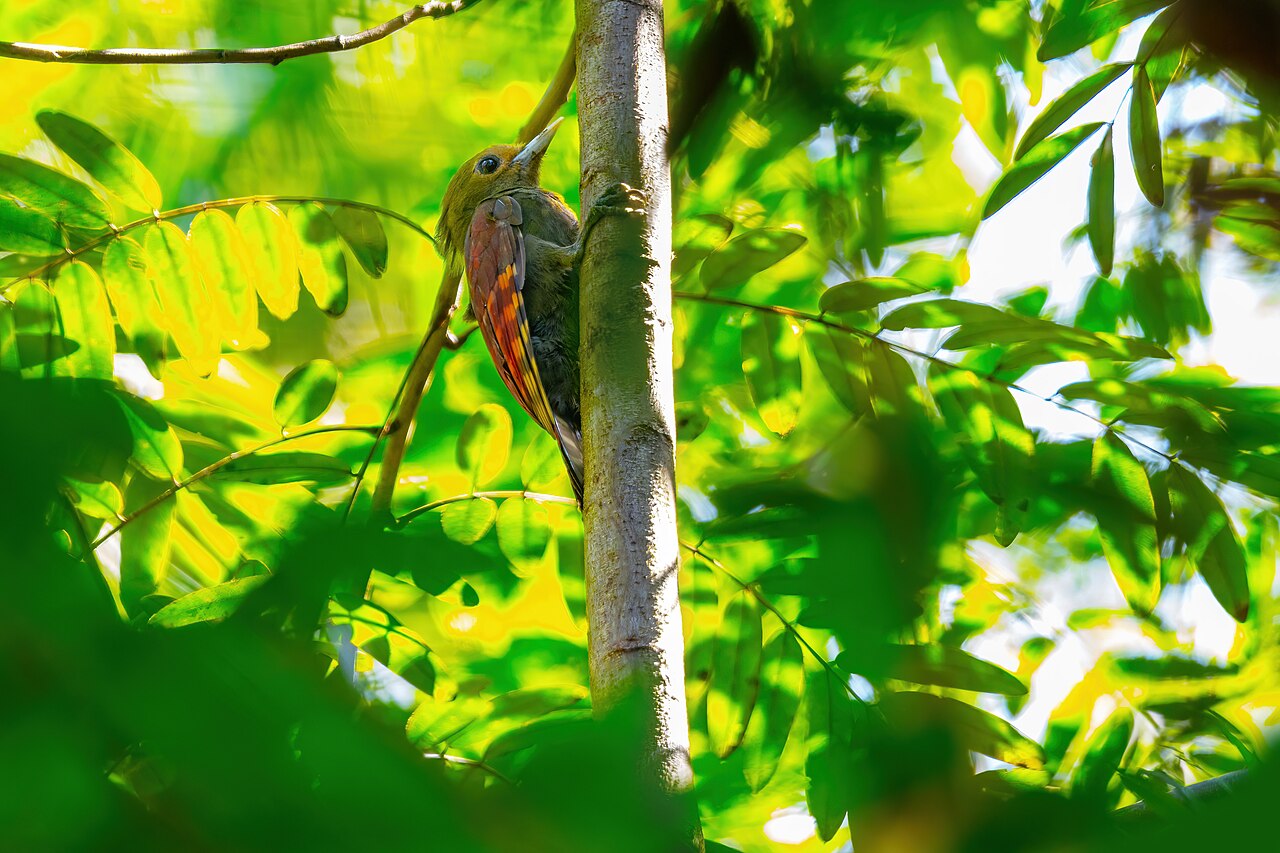
The pale-headed jacamar is a species of bird in the family Galbulidae. It is found in Colombia and Venezuela.
Region
Northern South America
Typical Environment
Occurs in northeastern Colombia and northwestern Venezuela, especially around the Maracaibo Basin and adjacent foothills. It favors lowland and foothill forests, semi-deciduous woodland, gallery forest along rivers, and tall secondary growth. Often found at forest edges, along clearings, and near watercourses where aerial insect activity is high. Uses exposed midstory to canopy perches from which it launches short sallies to catch prey.
Altitude Range
0–1000 m
Climate Zone
Tropical
Ease of Keeping
Beginner friendly: 1/5
This jacamar is a sit-and-wait insect hunter that sallies from exposed perches to snatch flying insects with a swift, precise strike. It is part of the Galbulidae, a Neotropical family related to puffbirds and kingfishers. Pale-headed jacamars often nest in burrows excavated in earthen banks or arboreal termitaria. Their pale head contrasts strongly with darker, glossy upperparts, making them distinctive in their limited range.


Temperament
quiet and watchful
Flight Pattern
short rapid wingbeats with quick sallies
Social Behavior
Typically found singly, in pairs, or small family groups. Pairs maintain small territories along forest edges and riparian corridors. They nest in burrows excavated in earthen banks or in arboreal termitaria, where both sexes participate in excavation and incubation.
Migratory Pattern
Resident
Song Description
Gives clear, thin whistles and sharp peet or see notes from exposed perches. Songs may be delivered in short, rising series, carrying well through edge habitat. Calls are often used in duet by pairs.
Plumage
Pale buff to whitish head and throat contrasting with dark, metallic green to bronzy upperparts and rufous-brown underparts. Feathers are smooth and glossy on the mantle and wings, with a sleeker, satiny appearance typical of jacamars.
Diet
Primarily captures flying insects such as butterflies, dragonflies, bees, wasps, beetles, and flying ants. It hunts by sallying from a fixed perch, returning to the same spot to swallow prey. Larger stinging insects are often beaten against the perch before being eaten. Feeding is visual and depends on good light and open airspace.
Preferred Environment
Forages along forest edges, riverbanks, and light gaps where aerial insect traffic is concentrated. Frequently uses midstory or canopy-height exposed branches and snags overlooking open lanes.