
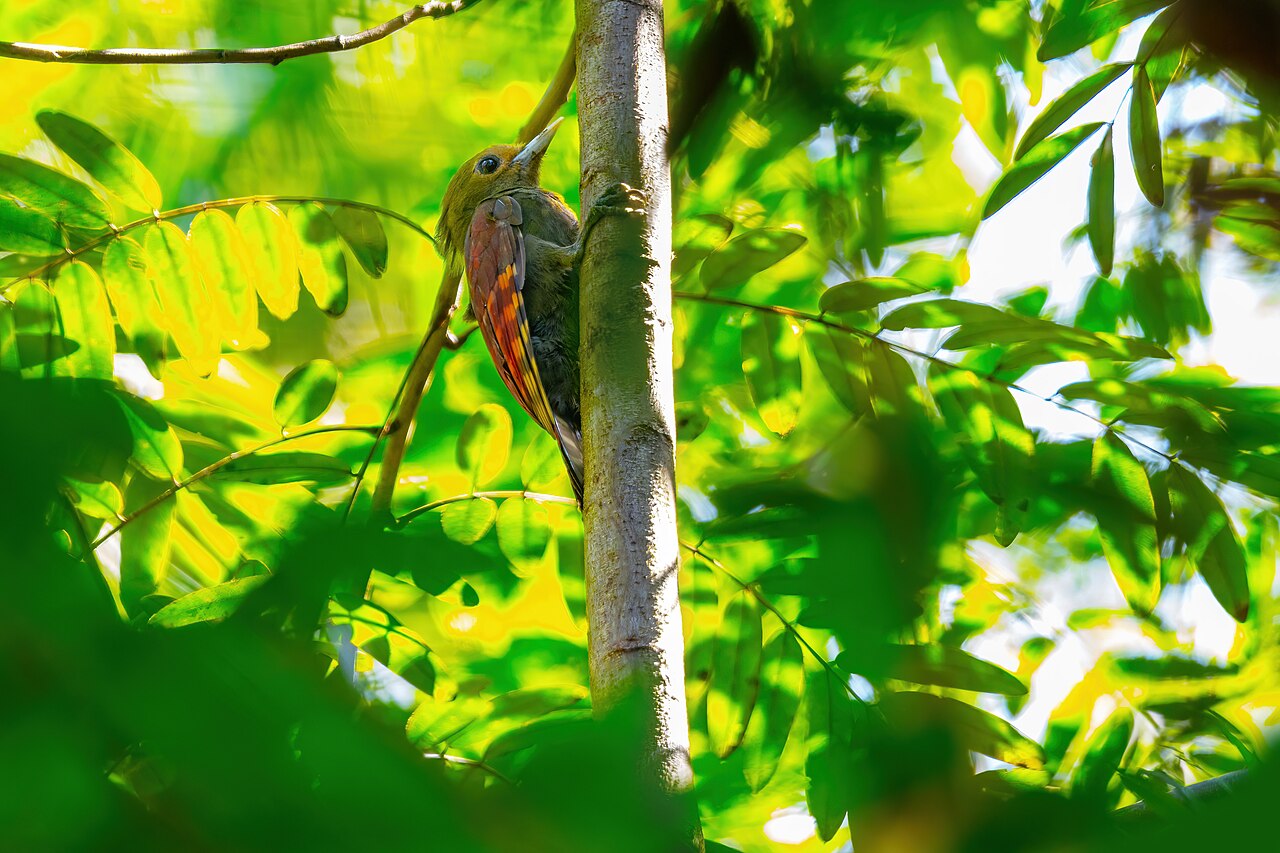
The pale-headed woodpecker is a species of bird in the family Picidae. It is found in Bangladesh, Bhutan, China, India, Laos, Myanmar, Nepal, Thailand, and Vietnam. Its natural habitats are subtropical or tropical dry forests and subtropical or tropical moist lowland forests. It is a bamboo specialist, and a montane bird.
Region
South and Southeast Asia
Typical Environment
Occurs from the Himalayan foothills through northeastern India and Bangladesh to Myanmar, Thailand, Laos, Vietnam, southern China, Nepal, and Bhutan. It favors subtropical and tropical moist lowland and foothill forests with abundant bamboo and also uses dry forests where bamboo is present. Often along forest edges, streamside bamboo, and secondary growth. Forages mainly within dense bamboo stands and adjacent understory.
Altitude Range
Sea level to 2000 m
Climate Zone
Tropical
Ease of Keeping
Beginner friendly: 1/5
A shy bamboo specialist, the pale-headed woodpecker forages quietly in dense thickets and is easy to overlook. It often probes and pecks into bamboo culms to extract ants and beetle larvae rather than performing loud drumming. Pairs or small family groups are typical, and the species may join mixed flocks in forest undergrowth. Its pale head contrasts with olive upperparts and a warmer rufous rump.

Temperament
shy and inconspicuous
Flight Pattern
undulating with short rapid wingbeats
Social Behavior
Usually seen singly, in pairs, or small family groups, moving methodically through bamboo. Often associates with mixed-species flocks in the understory. Nests in cavities excavated in soft wood or dead bamboo, with both sexes participating in excavation and care.
Migratory Pattern
Resident
Song Description
Vocalizations are soft, including thin whistles and high-pitched notes given from within bamboo. Drumming is weak and infrequent compared to many other woodpeckers.
Plumage
Pale buff to creamy head and nape contrasting with olive-brown upperparts and dusky, lightly streaked underparts. Rump and vent show warm rufous tones; flight feathers are darker with paler edging. Feathers appear smooth and fairly plain overall, aiding camouflage in bamboo.
Diet
Primarily takes insects such as ants, termites, beetles, and their larvae. Gleans from bamboo culms and probes into internodes and dead stems to reach concealed prey. Will also pick small arthropods from leaves and twigs and occasionally take other invertebrates.
Preferred Environment
Dense bamboo thickets within lowland and foothill forests, especially along streams and forest edges. Forages from near ground level up to mid-story, favoring areas with abundant dead or mature bamboo.


