

The oriental pratincole, also known as the grasshopper-bird or swallow-plover, is a wader in the pratincole family, Glareolidae.
Region
South, Southeast, and East Asia to northern Australia
Typical Environment
Breeds from the Indian subcontinent and Myanmar through southern China and Southeast Asia, with many birds wintering in Indonesia, New Guinea, and northern Australia. Uses open country such as grasslands, dry fallows, riverbeds, coastal saltpans, and airfields. During migration and in the nonbreeding season it frequents wetlands and agricultural landscapes where aerial insects are abundant. Often forms large foraging flocks over expansive open habitats.
Altitude Range
0–1500 m
Climate Zone
Tropical
Ease of Keeping
Beginner friendly: 1/5
The oriental pratincole is a wader that feeds on the wing like a swallow, often earning the nickname ‘swallow-plover’. It breeds on open ground in loose colonies and can gather in very large flocks outside the breeding season. Remarkably agile in flight, it snaps up aerial insects over fields, wetlands, and coastal flats.



Temperament
social and active
Flight Pattern
agile with rapid wingbeats and swift-like glides
Social Behavior
Typically nests in loose colonies on bare or sparsely vegetated ground, with a simple scrape for a nest. Pairs are monogamous during the breeding season, and both sexes share incubation and chick-rearing. Outside breeding, they form flocks that can number into the thousands.
Migratory Pattern
Seasonal migrant
Song Description
Calls are soft, trilling chatter and sharp prree or chitt notes, often given in flight. Vocal activity increases at dawn and dusk over feeding areas.
Plumage
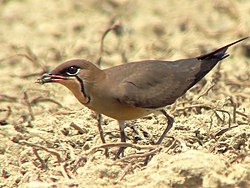
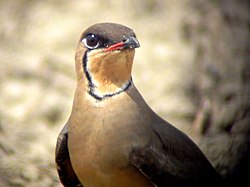
Smooth sandy-brown upperparts with paler buff underparts and a rufous throat neatly outlined by a fine black line. Long, pointed wings with dark primaries and a short, shallowly forked tail. In flight, the underwing appears dark with a pale trailing edge.
Diet
Primarily takes flying insects such as beetles, termites, locusts, and moths. Hunts on the wing, often low over fields and wetlands, snatching prey with quick, precise turns. Will also glean insects from the ground when conditions are suitable.
Preferred Environment
Feeds over open habitats including grasslands, agricultural fields, mudflats, saltpans, and the margins of wetlands. Often forages along with other aerial insectivores where insect swarms concentrate.


