

The Oriental turtle dove or rufous turtle dove is a member of the bird family Columbidae. The species has a wide native distribution range from Central Asia east across Asia to Japan. The populations show variations in the patterning of plumage and have been designated into at least six named subspecies. Populations in the higher latitudes tend to migrate south in winter, while those closer to the tropics are sedentary. Vagrants have been recorded in North America. The species is predominantly granivorous and forages on the ground.
Region
Central, East, and South Asia
Typical Environment
Breeds across temperate Asia from Central Asia and southern Siberia through Mongolia, northern China, Korea, and Japan, with wintering populations moving into South Asia and parts of Southeast Asia. It favors open woodlands, forest edges, riverine groves, orchards, and agricultural landscapes. In winter it frequents fields, stubble, scrub, and village edges. Northern populations are migratory, while those closer to the tropics are largely resident. Vagrants occasionally appear well outside the core range, including the Middle East and North America.
Altitude Range
0–3000 m
Climate Zone
Temperate
Ease of Keeping
Beginner friendly: 2/5
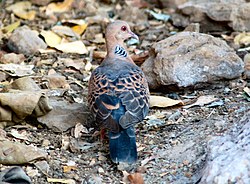
The Oriental turtle dove is larger and darker than the European turtle dove and shows a distinctive black-and-white barred patch on the side of the neck. Its rufous wings with dark centers create a scaly pattern that is a key field mark. Several subspecies vary in tone and pattern across its wide Asian range. Its deep, rolling coo carries far and is often heard from forest edges and farmlands.


S. o. meena from the central Himalayas

Egg of Streptopelia orientalis



Temperament
wary but often loosely social
Flight Pattern
strong flier with fast, direct flight
Social Behavior
Typically seen singly or in small groups during breeding, forming larger flocks in winter where food is abundant. Pairs are monogamous and build a flimsy stick platform in trees or tall shrubs. Clutches are usually two eggs, with both parents sharing incubation and chick care.
Migratory Pattern
Partial migrant
Song Description
A deep, rolling series of coos delivered from a perch, often described as a soft, resonant hooo-hoo-hoo sequence. Calls are lower and more booming than those of the European turtle dove and can carry across open country.
Plumage
Rufous-brown upperparts with dark-centered feathers giving a scaled effect; bluish-grey head and nape with a black-and-white barred neck patch; pinkish-buff breast and pale belly; broad tail with white edges and tips.
Diet
Primarily granivorous, taking seeds of grasses, cereals, and weeds such as millet, amaranth, and various agricultural grains. It also consumes small berries and green plant material when available. Occasional ingestion of small invertebrates may occur incidentally while foraging on the ground.
Preferred Environment
Usually feeds on the ground in open fields, stubble, tracksides, and at the margins of woodland. Will also forage in harvested agricultural areas and village edges where spilled grain is available.


