

The Oriental reed warbler is a passerine bird of eastern Asia belonging to the reed warbler genus Acrocephalus. It was formerly classified as a subspecies of the great reed warbler of the western Palearctic.
Region
East and Southeast Asia
Typical Environment
Breeds in marshes, lakesides, and river floodplains with extensive stands of reeds and tall rank vegetation across northeastern China, the Korean Peninsula, Japan, and the Russian Far East. In the non-breeding season it migrates to Southeast Asia, including southern China, Taiwan, the Philippines, and parts of Indonesia. It favors dense Phragmites and Typha reedbeds but also uses rice paddies, wet meadows, and willow-fringed waterways. During migration it can appear in a variety of lowland wetlands and coastal reedbeds. Human-modified wetlands such as rice fields are commonly used where reeds persist.
Altitude Range
Sea level to 1500 m
Climate Zone
Temperate
Ease of Keeping
Beginner friendly: 1/5
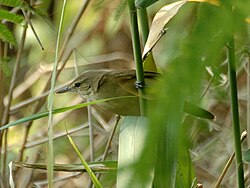
The Oriental reed warbler is a large Acrocephalus warbler breeding in reedbeds across East Asia and wintering in Southeast Asia. It is a frequent host of brood-parasitic cuckoos, leading to notable egg-recognition defenses in some populations. Often seen singing from exposed reed stems, it can also be quite skulking while foraging. It was once treated as a subspecies of the great reed warbler but is now recognized as a distinct species.


Temperament
secretive but vocal
Flight Pattern
short rapid wingbeats over reeds
Social Behavior
Generally solitary or in pairs during the breeding season, defending territories within reedbeds. Builds a deep cup nest suspended between reed stems, typically close to the water surface. Both sexes participate in nesting duties; brood parasitism by cuckoos is locally common.
Migratory Pattern
Seasonal migrant
Song Description
A loud, varied, and rhythmic series of harsh chattering phrases interspersed with whistles and mimicry. Songs are delivered from exposed perches atop reeds, especially at dawn and dusk.
Plumage
Warm brown upperparts with slightly rufous tones, paler buff underparts, and a whitish throat; plumage is plain with fine streaking minimal or absent.
Diet
Primarily consumes insects such as beetles, flies, caterpillars, grasshoppers, and spiders; also takes larvae and other small invertebrates gleaned from reed stems and foliage. It occasionally snaps prey in short flights or hover-gleans at reed heads. Non-breeding birds may supplement with small berries when insects are scarce.
Preferred Environment
Feeds within dense reedbeds, along reed margins, and in adjacent wet scrub and rice paddies. Often forages low in vegetation but will also climb reed stems and probe leaf sheaths.


