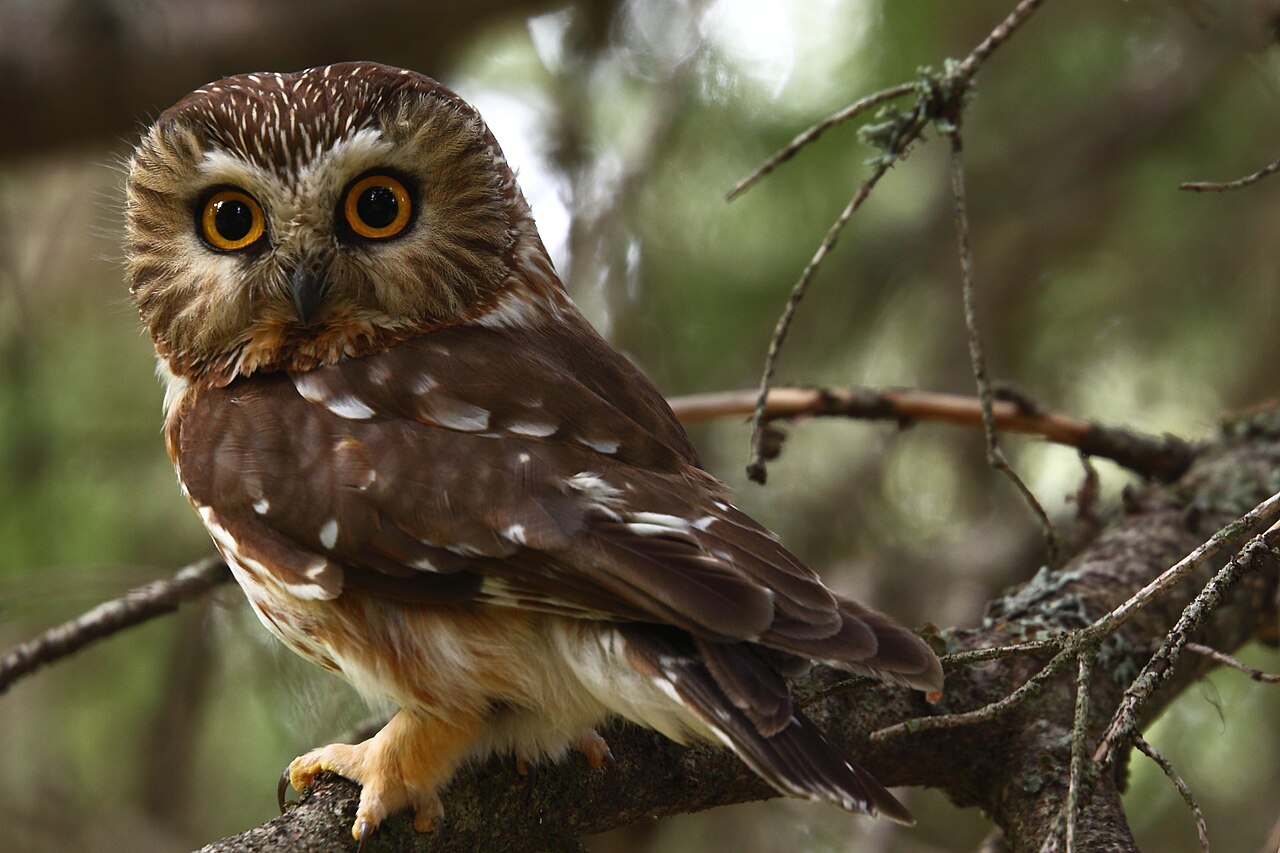
The northern saw-whet owl is a species of small owl in the family Strigidae. The species is native to North America. Saw-whet owls of the genus Aegolius are some of the smallest owl species in North America. They can be found in dense thickets, often at eye level, although they can also be found some 20 ft (6.1 m) up. Saw-whets are often in danger of being preyed upon by larger birds of prey. The northern saw-whet owl is a migratory bird without any strict pattern.
Region
North America
Typical Environment
Breeds widely in boreal, montane, and northern temperate forests across Canada, the northern United States, and locally in higher elevations farther south. Prefers dense coniferous or mixed forests with thick understory and available tree cavities for nesting. In winter it disperses broadly, including into lowland forests, wooded edges, and shrubby habitats, sometimes near towns. It roosts low in dense thickets and hunts along forest edges and small openings.
Altitude Range
Sea level to 3000 m
Climate Zone
Temperate
Ease of Keeping
Beginner friendly: 1/5
This tiny owl is famously detected by its repetitive, high-pitched “too-too-too” call, reminiscent of a saw being sharpened. It nests in tree cavities, often those made by woodpeckers, and may cache surplus prey in cold weather. Many individuals make irregular, sometimes long-distance migrations, turning up at coastal and inland banding stations in autumn. Despite their size, they are efficient nocturnal hunters specialized on small mammals.


Northern saw-whet owl in Ontario, Canada

Three juveniles in Oregon, United States

On a daytime hunt in a brushy area, Homer, Alaska

Gus, A Saw-whet Owl, Shown At A Summer Program In Harlem, 2023
Temperament
solitary and territorial
Flight Pattern
short rapid wingbeats; silent, agile flier through dense cover
Social Behavior
Typically solitary outside the breeding season and roosts alone in dense foliage. Nests in natural cavities or old woodpecker holes; does not excavate its own nest. Pairs are generally monogamous; males provide most of the food while the female incubates and broods.
Migratory Pattern
Partial migrant
Song Description
A monotonous series of clear, whistled “too-too-too” notes at a steady tempo, often delivered for minutes on end at night. Also gives sharp, high-pitched squeaks and soft mews near the nest.
Plumage
Compact owl with a rounded head and no ear tufts; rich brown upperparts speckled with white and buffy, with whitish underparts boldly streaked with rufous-brown.
Diet
Primarily hunts small mammals such as deer mice, voles, and shrews, taken with swift pounces from low perches. Will also capture small birds and large insects, especially outside the breeding season. Often decapitates prey and may cache extra items in cold conditions.
Preferred Environment
Forages along forest edges, clearings, and dense thickets, usually from low to mid-level perches. Uses cover to approach prey quietly and relies heavily on acute hearing to locate movement under leaf litter or snow.