

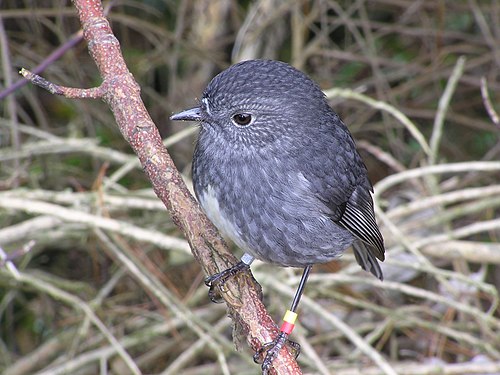
The North Island robin is a species of Australasian robin endemic to the North Island of New Zealand. It and the South Island robin of the South Island and Stewart Island were once considered conspecific, but mitochondrial DNA sequences have shown that the two lineages split prior to the Pleistocene, and support the classification as two different species.
Region
New Zealand (North Island)
Typical Environment
Found in native and regenerating forests, including podocarp–broadleaf and beech remnants, as well as pest-free offshore islands and fenced mainland sanctuaries. It favors dense understorey with abundant leaf litter and fallen logs for ground foraging. Birds use low branches and trunks as perches for scanning prey and make short sallies to the forest floor. It occupies both mature and secondary growth, and can persist in forest fragments where predators are controlled.
Altitude Range
Sea level to 1200 m
Climate Zone
Temperate
Ease of Keeping
Beginner friendly: 1/5
A confiding forest bird, the North Island robin often approaches people closely and will forage around disturbed leaf litter. It was once lumped with the South Island robin but genetic evidence confirms they are distinct species. Populations respond well to predator control and have been re-established on several predator-free sanctuaries.


Approximate distribution of the North Island Robin.


Temperament
confiding yet territorial
Flight Pattern
short rapid wingbeats
Social Behavior
Typically seen as pairs holding year-round territories, with strong site fidelity. Monogamous breeding is common; nests are cup-shaped and placed on ledges, forks, or cavities on tree trunks. Males often feed incubating females and both parents provision fledglings.
Migratory Pattern
Resident
Song Description
A clear, melodious series of ringing notes delivered from low to mid-level perches. Calls include sharp ticking alarms and soft contact notes between mates.
Plumage
Charcoal-grey to dark grey upperparts with paler grey underparts and a whitish lower belly; females and juveniles are browner. Feathers are soft and plain without wing bars, giving a clean, uniform look. The stance is upright with relatively long legs and frequent tail and wing flicking.
Diet
Primarily takes ground-dwelling invertebrates such as beetles, spiders, caterpillars, and worms, along with native wētā and other arthropods. It uses watch-and-pounce tactics from low perches and will glean from trunks and leaf litter. Occasionally eats small fruits or berries and may cache surplus prey in crevices.
Preferred Environment
Feeds in shaded forest floors, among leaf litter, roots, and fallen logs, and on low trunks and branches. Often forages along tracks or recently disturbed patches where prey is exposed, including around foraging mammals or human footfall.


