

The mountain hawk-eagle or Hodgson's hawk-eagle, is a large bird of prey native to Asia. The latter name is in reference to the naturalist, Brian Houghton Hodgson, who described the species after collecting one himself in the Himalayas. A less widely recognized common English name is the feather-toed eagle. Like all eagles, it is in the family Accipitridae. Its feathered tarsus marks this species as a member of the subfamily Aquilinae. It is a confirmed breeding species in the northern part of the Indian subcontinent, from India, Nepal through Bangladesh to Thailand, Taiwan, Vietnam and Japan, although its distribution could be wider still as breeding species. Like other Asian hawk-eagles, this species was earlier treated under the genera of Spizaetus but genetic studies have shown this group to be paraphyletic, resulting in the Old World members being placed in Nisaetus and separated from the New World species. As is typical of hawk-eagles, the mountain hawk-eagle is a forest dwelling opportunistic predator who readily varies its prey selection between birds, mammals and reptiles along with other vertebrates. Although classified currently as a least-concern species due its persistence over a rather wide distribution, this species is often quite rare and scarce and seems to be decreasing, especially in response to large-scale habitat degradation and deforestation.
Region
Himalayas to East Asia
Typical Environment
Occurs from the Himalayan foothills of northern India and Nepal east through Bhutan, Bangladesh, and Myanmar into southern China, mainland Southeast Asia, and Taiwan, reaching Japan. It inhabits mature evergreen and mixed montane forests, also using steep valleys, ridgelines, and forest edges. In Japan it may range down to lowland forests, while in the Himalayas it is mostly montane. It prefers large, contiguous tracts of woodland with tall nesting trees and varied canopy structure.
Altitude Range
Sea level to 3500 m
Climate Zone
Highland
Ease of Keeping
Beginner friendly: 1/5
Also known as Hodgson's hawk-eagle, this powerful raptor is a forest specialist with feathered tarsi, earning the nickname 'feather-toed eagle.' It was long placed in Spizaetus but Old World hawk-eagles are now in Nisaetus based on genetics. It shows marked geographic variation, with particularly robust birds in Japan. Despite a wide range, it is often scarce and sensitive to forest loss.


Mountain hawk-eagles are the largest and most robust of the hawk-eagles in the genus Nisaetus.

Drawing of the Japanese race by Yūshi Ishizaki, from the 1830s.

A subadult mountain hawk-eagle in flight in Singapore.

A mountain hawk-eagle adult.
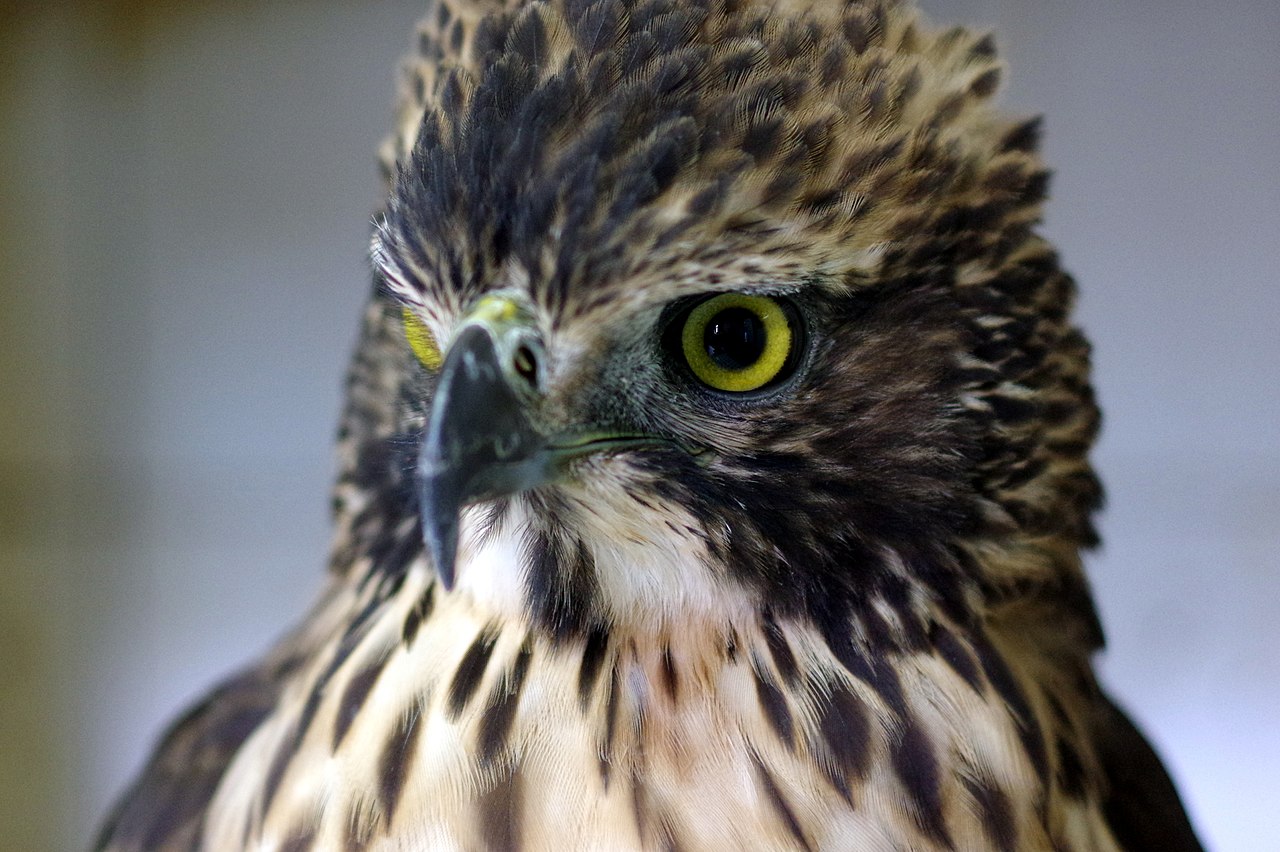
Close-up of a mountain hawk-eagle from China.

Mountain hawk-eagles often live in cooler, more temperate habitats including deciduous forest than other hawk-eagles.

A mountain hawk-eagle stooping down among the trees in Uttarakhand.

Small to medium-sized mammals such as the Japanese hare seem to form the bulk of the mountain hawk-eagle's diet.

A mountain hawk-eagle in the little-known (and cartographically undescribed) population in Primorsky Krai in Russia.

A mountain hawk-eagle in flight.

A female mountain hawk-eagle in Japan dismantles prey on her nest.

An adult mountain hawk-eagle.

A captive specimen of the threatened Japanese subspecies, N. n. orientalis.
Temperament
solitary and territorial
Flight Pattern
soaring glider with powerful flaps and short rapid dashes through forest
Social Behavior
Typically observed alone or in pairs, maintaining large territories year-round. Monogamous pairs build substantial stick nests high in tall trees and usually raise a single chick. Courtship includes soaring displays and vocal duets. Both sexes defend the nest vigorously.
Migratory Pattern
Partial migrant
Song Description
Calls are high-pitched, piercing whistles and screams, often given in display flight. Near nests it produces sharp, repeated kiii or kiew notes, with more rapid sequences during agitation.
Plumage
Dark brown upperparts with paler mottling; underparts whitish to buff with bold dark streaking and barring. Tail is long with broad dark bands; tarsi are fully feathered. Prominent, erect crest gives a distinctive hawk-eagle profile.
Diet
An opportunistic predator of medium-sized birds and mammals, including pheasants, pigeons, corvids, squirrels, flying squirrels, and hares; it may also take reptiles. It hunts from concealed perches or by soaring along slopes, launching swift ambushes through canopy gaps. Prey size is often substantial relative to the eagle, and it can subdue agile avian prey in mid-forest.
Preferred Environment
Hunts along forest edges, ridgelines, and mixed-canopy slopes where updrafts aid soaring. Frequently uses tall vantage trees overlooking clearings, streams, or trails to watch for movement. Avoids heavily degraded or open habitats.


