
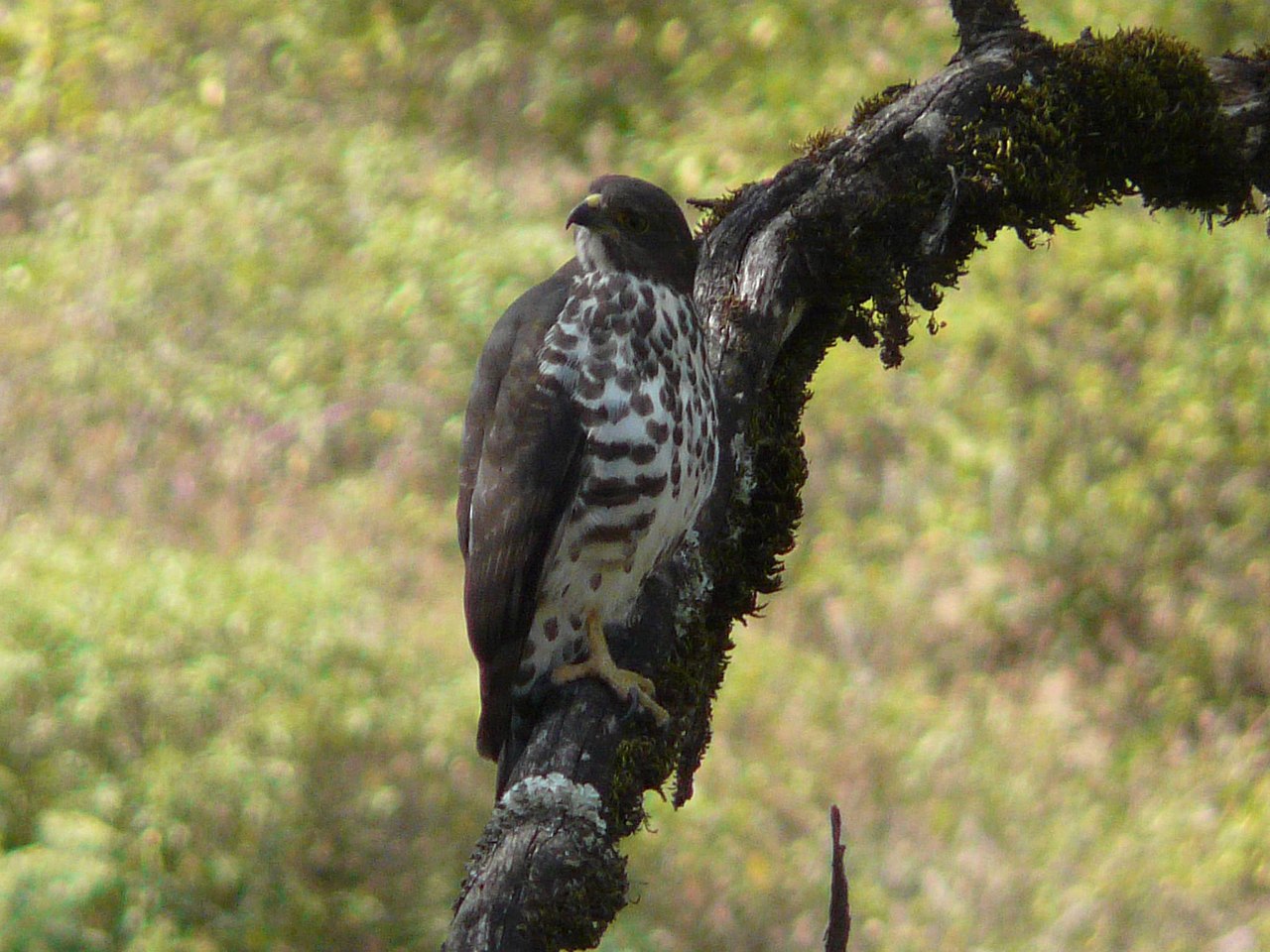
The mountain buzzard is a bird of prey that lives in montane forests in East Africa, it and the forest buzzard of southern Africa were, until recently, considered to be a single species.
Region
East African Highlands
Typical Environment
This species inhabits montane evergreen forests, bamboo zones, and moist forest edges from Ethiopia south through Kenya, Uganda, Rwanda, Burundi, northeast Democratic Republic of the Congo, and northern Tanzania. It favors mosaic landscapes where closed canopy forest meets glades, clearings, and plantations, which provide perches and hunting lanes. Birds often patrol along ridgelines and valleys, using thermals to soar and scan for prey. It will also occur in secondary growth and selectively logged forest as long as tall trees remain for nesting.
Altitude Range
1200–3500 m
Climate Zone
Highland
Ease of Keeping
Beginner friendly: 1/5
The mountain buzzard is a forest-dwelling raptor of the East African highlands, often seen soaring over ridgelines and hunting along forest edges. It was formerly lumped with the forest buzzard of southern Africa but is now recognized as a distinct species. It performs local upslope and downslope movements following prey availability and weather. Its mewing calls can carry far across valleys on calm mornings.

Temperament
solitary and territorial
Flight Pattern
soaring glider
Social Behavior
Typically occurs singly or in pairs that defend forested territories. Pairs build stick nests high in tall trees and are largely monogamous. Clutches are small, usually one to two eggs, and the female incubates while the male provides prey.
Migratory Pattern
Partial migrant
Song Description
The call is a high, mewing whistle, often given while soaring. It may repeat plaintive notes in series, carrying well over valleys. At the nest, softer whines and whistles are used in pair communication.
Plumage
Upperparts are dark brown with subtle mottling; underparts are creamy to whitish with brown streaking on the breast and fine barring on the belly and flanks. The underwings show dark carpal patches and barred secondaries and tail. Tail is brown with narrow pale bars and a darker subterminal band. Cere and legs are yellow; bill is black-tipped.
Diet
It preys on small mammals such as rodents and shrews, small birds, reptiles, and large insects. Hunting is typically from a perch with quick stoops to the ground or low vegetation, but it also quarters slowly along forest edges. It will take prey flushed by edge disturbances and sometimes snatches items from branches or the forest floor. Opportunism is common, with diet shifting to what is locally abundant.
Preferred Environment
Most hunting occurs along forest edges, clearings, glades, and roads cut through montane forest. It also uses open perches on ridgelines and tall snags within the canopy. In agricultural mosaics near forest, it may hunt over pasture and plantations.


