

The Montezuma quail is a stubby, secretive New World quail of Mexico and some nearby parts of the United States. It is also known as Mearns's quail, the harlequin quail, and the fool quail.
Region
Southwestern United States and Mexican Highlands
Typical Environment
Occurs from southeastern Arizona, New Mexico, and west Texas south through the Sierra Madre ranges and Mexican Plateau into central and southern Mexico. Prefers oak savannas, pine–oak woodlands, and adjacent grasslands with dense bunchgrasses for cover. Often found on steep, rocky slopes, canyons, and foothills where soils allow digging for bulbs. Requires nearby grassy cover and avoids large expanses of open, heavily grazed ground.
Altitude Range
900–3000 m
Climate Zone
Highland
Ease of Keeping
Beginner friendly: 2/5
Also called Mearns's quail or harlequin quail, this stubby, secretive quail specializes in digging for underground bulbs and tubers. It spends much of its time hidden in bunchgrasses on oak-wooded hillsides, flushing only at close range with a sudden burst. Males have one of the most striking face patterns of any North American quail. Despite local declines at the edges of its range, the species is broadly secure.


Illustration of crest by Louis Agassiz Fuertes

Adult male (illustration)
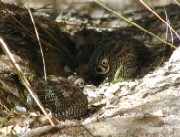
Males at Coronado National Memorial
Temperament
secretive and wary
Flight Pattern
short rapid wingbeats with explosive flush, then dropping quickly into cover
Social Behavior
Typically found in pairs during breeding season and in small family coveys the rest of the year. Nests are shallow ground scrapes hidden beneath bunchgrasses or low shrubs. Pairs are monogamous, and males help attend the brood, guiding chicks to food-rich patches.
Migratory Pattern
Resident
Song Description
The male gives soft, clear, descending whistles, often a spaced series heard at dawn or dusk. Contact calls within coveys are low, buzzy clucks and peeps that help maintain cohesion in dense cover.
Plumage
Male shows a bold harlequin pattern with black-and-white facial markings, scalloped gray upperparts, and rich chestnut flanks thickly spotted with white. Female is cryptic buffy-brown with fine mottling and scalloping, blending well with dry grasses. Both sexes are compact with a short tail and rounded wings.
Diet
Specializes in underground bulbs, corms, and tubers of sedges, lilies, and wild onions, which it excavates with strong legs and claws. Also eats seeds, green plant material, and seasonally abundant insects such as beetles, ants, and grasshoppers, especially during chick-rearing. Diet shifts with rainfall and soil softness, increasing bulb foraging after wet periods.
Preferred Environment
Forages on grassy slopes, canyon sides, and open understories of oak–pine woodlands where bunchgrasses provide both food and concealment. Often feeds near rocky outcrops and along edges where soft soil is interspersed with dense cover.


