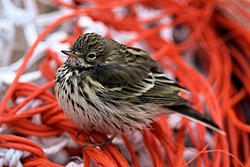
The meadow pipit is a small passerine bird that breeds throughout much of the Palearctic, from south-eastern Greenland and Iceland east to just east of the Ural Mountains in Russia, and south to central France and Romania; an isolated population also occurs in the Caucasus Mountains. It is migratory over most of its range, wintering in southern Europe, North Africa, and south-western Asia, but is resident year-round in western Europe, although even here many birds move to the coast or lowlands in winter.
Region
Palearctic
Typical Environment
Breeds widely from Iceland and Greenland’s southeast across the British Isles and much of northern and central Europe to western Russia and the Caucasus. It favors open landscapes such as moorland, heath, rough grassland, upland bogs, and coastal dunes. In winter many birds move south and west into southern Europe, North Africa, and southwestern Asia, with some remaining in milder parts of western Europe. It often shifts to lowlands and coastal marshes or estuaries in colder months. During migration it can appear in diverse open habitats, including agricultural fields and fallow land.
Altitude Range
Sea level to 2000 m
Climate Zone
Temperate
Ease of Keeping
Beginner friendly: 1/5
The meadow pipit is a small, streaky songbird common across open habitats in the Western Palearctic. Males perform distinctive parachuting song flights during the breeding season. It is a primary host for the common cuckoo in parts of Europe. Outside the breeding season it often forms loose flocks and frequents coastal areas and farmland.




Temperament
social and active
Flight Pattern
short rapid wingbeats with bounding, undulating flight; males perform parachuting song-flights
Social Behavior
Breeds in open ground, nesting in a grass-lined cup concealed at the base of vegetation. Pairs are territorial in the breeding season, and the male displays with aerial song flights. Clutches typically contain 4–6 eggs, and the species is a frequent host of the common cuckoo. In autumn and winter it often forms loose flocks and roosts communally.
Migratory Pattern
Partial migrant
Song Description
The song is a high, tinkling series of trills and twitters, often delivered during a descending parachute display. Calls include a thin, high 'seep' or 'tsip' given in flight and when alarmed. The song is repetitive but carries well over open ground.
Plumage
Fine, streaky brown upperparts with darker mottling; buff underparts with bold dark streaks on the breast and flanks; white outer tail feathers visible in flight.
Diet
Primarily consumes small invertebrates such as beetles, flies, spiders, and caterpillars, gleaned from the ground and low vegetation. In winter it supplements its diet with seeds and small plant material. Along coasts it also picks tiny crustaceans and invertebrates from wrack and mud. Food is taken mostly by walking and picking, with occasional short sallies.
Preferred Environment
Feeds on short grass, rough pasture, moorland, and heath, where low vegetation allows easy ground foraging. In winter it frequents stubble fields, saltmarsh edges, and tidal strandlines. It prefers open, unobstructed areas with scattered tussocks for cover.