

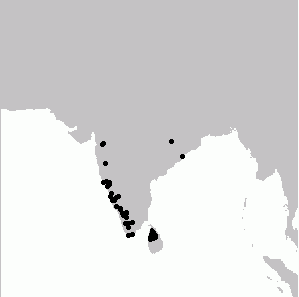
The Malabar trogon is a species of bird in the trogon family. It is found in the forests of India and Sri Lanka. In India it is mainly found in the Western Ghats, hill forests of central India and in parts of the Eastern Ghats. They are insectivorous and although not migratory, may move seasonally in response to rain in hill forest regions. Like in other trogons, males and females vary in plumage. The birds utter low guttural calls that can be heard only at close quarters and the birds perch still on a branch under the forest canopy, often facing away from the viewer making them easy to miss despite their colourful plumage.
Region
Western Ghats of India and Sri Lanka
Typical Environment
This species inhabits evergreen and moist deciduous forests of southwestern India and the wet zone of Sri Lanka. It prefers dense, shaded understory and mid‑story of primary forest, but also uses mature secondary growth and riparian corridors. Birds are most often found along forested streams, sholas, and in well-canopied slopes, avoiding open country. They tend to keep to interior forest, where their still perching behavior helps them remain concealed.
Altitude Range
Sea level to 2000 m
Climate Zone
Tropical
Ease of Keeping
Beginner friendly: 1/5
The Malabar trogon is a quiet forest specialist that often perches motionless in deep shade, making it surprisingly hard to spot despite its vivid colors. Males and females are strongly dimorphic, with the male showing striking black-and-crimson contrasts and the female warmer browns and cinnamon tones. It is mostly insectivorous and may make local seasonal movements in response to rainfall patterns in hill forests.


Female

An immature male with scaly orange underparts

Illustration by John Gould (1854)
Temperament
quiet and unobtrusive
Flight Pattern
short rapid wingbeats with brief direct flights
Social Behavior
Usually seen singly or in pairs, sometimes joining mixed-species flocks in the mid‑story. Nests in cavities excavated in soft or rotting wood, with both sexes participating in nesting. Pairs maintain small territories within suitable forest patches.
Migratory Pattern
Resident
Song Description
Gives low, guttural notes and soft ‘tuk-tuk’ or ‘kow-kow’ series that carry only a short distance. Calls are often heard at close quarters from shaded perches under the canopy.
Plumage
Male with black head, throat, and upper breast, rich rufous back, finely barred dark wings, and bright crimson belly with white-tipped, graduated tail; female with warm brown head and breast, cinnamon underparts, and rufous-brown back with similar barred wings.
Diet
Primarily hunts insects such as caterpillars, beetles, mantises, and orthopterans, often taken by sally-gleaning from a perch. It also hawks flying insects in short sallies and plucks prey from foliage and hanging dead leaves. Small fruits and berries are taken occasionally, especially when insect availability is low.
Preferred Environment
Feeds in the shaded mid‑story and lower canopy of evergreen and moist deciduous forests, often along streams and in ravines. It favors areas with dense foliage where it can perch quietly and scan for prey.


