

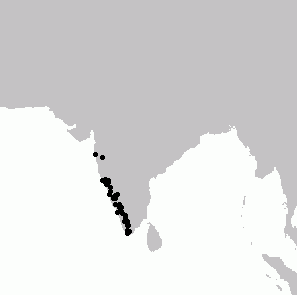
The Malabar gray hornbill is a hornbill endemic to the Western Ghats and associated hills of southern India. They have a large beak but lack the casque that is prominent in some other hornbill species. They are found mainly in dense forest and around rubber, arecanut or coffee plantations. They move around in pairs or small groups, feeding on figs and other forest fruits. Their loud cackling and laughing call makes them familiar to people living in the region.
Region
Western Ghats, Southwestern India
Typical Environment
Occurs in the Western Ghats and adjacent hill ranges of southern India, inhabiting evergreen and moist deciduous forests. It readily uses mosaic landscapes with fruiting trees, including rubber, arecanut, and coffee plantations. Prefers mid- to upper-canopy strata and forest edges where figs are abundant. Nests in large tree cavities within mature forest or well-wooded estates. Often moves locally following fruiting cycles.
Altitude Range
0–1500 m
Climate Zone
Tropical
Ease of Keeping
Beginner friendly: 1/5
This hornbill lacks the prominent casque seen in many relatives, giving it a sleeker profile despite its hefty, decurved bill. It is a key seed disperser for figs and other forest trees in the Western Ghats, often ranging between forest and plantations. Females seal themselves into tree cavities during nesting, relying on the male to deliver food through a narrow slit. Their loud, laughing calls carry far and are a familiar sound in southwestern India.



An adult male

Temperament
social and active
Flight Pattern
strong flier with direct flight and loud wingbeats
Social Behavior
Usually seen in pairs or small family groups, sometimes joining mixed-fruit feeding aggregations. Forms long-term pair bonds and nests in tree cavities; the female is sealed inside with a mud-and-pulp wall while the male provisions her and the chicks. Post-breeding family parties roam locally in search of fruit.
Migratory Pattern
Resident
Song Description
Vocal, with loud cackling, laughing calls that carry over long distances. Also gives nasal chattering and clucking notes during group movements.
Plumage
Overall grey to brownish-grey with paler underparts and a whitish throat; long graduated tail with pale tips.
Diet
Primarily frugivorous, taking figs (Ficus) and a variety of other berries and drupes. Supplements fruit with insects, small lizards, and occasionally other small animals, especially when feeding young. Plays an important ecological role by dispersing large seeds over considerable distances.
Preferred Environment
Feeds mainly in the mid- to upper-canopy of forest and along edges, often visiting fruiting fig trees. Frequently forages in shaded plantations and wooded village groves where native fruiting trees persist.


