

The Magellanic woodpecker is a species of large woodpecker found in southern Chile and southwestern Argentina; it is resident within its range. This species is the southernmost example of the genus Campephilus, which includes the famous ivory-billed woodpecker.
Region
Patagonia and Tierra del Fuego
Typical Environment
Occurs in temperate Andean-Patagonian forests of southern Chile and southwestern Argentina, including Tierra del Fuego. It favors mature and old-growth Nothofagus stands with abundant large-diameter trees and snags for foraging and nesting. The species also uses mixed forests and forest edges but generally avoids heavily fragmented or young secondary growth. It is frequently recorded in protected areas and remote forest tracts where dead wood is plentiful.
Altitude Range
Sea level to 1500 m
Climate Zone
Temperate
Ease of Keeping
Beginner friendly: 1/5
The Magellanic woodpecker is one of the largest woodpeckers in South America and the southernmost member of the genus Campephilus. It is strongly tied to mature southern beech (Nothofagus) forests and is often considered an indicator of old-growth habitat quality. Pairs advertise territories with powerful double-knocks and conspicuous drumming. Sexual dimorphism is striking: males have an all-red head and crest, while females have a black head with contrasting white facial markings.


Magellanic woodpecker, femaleMagellanic woodpecker, male
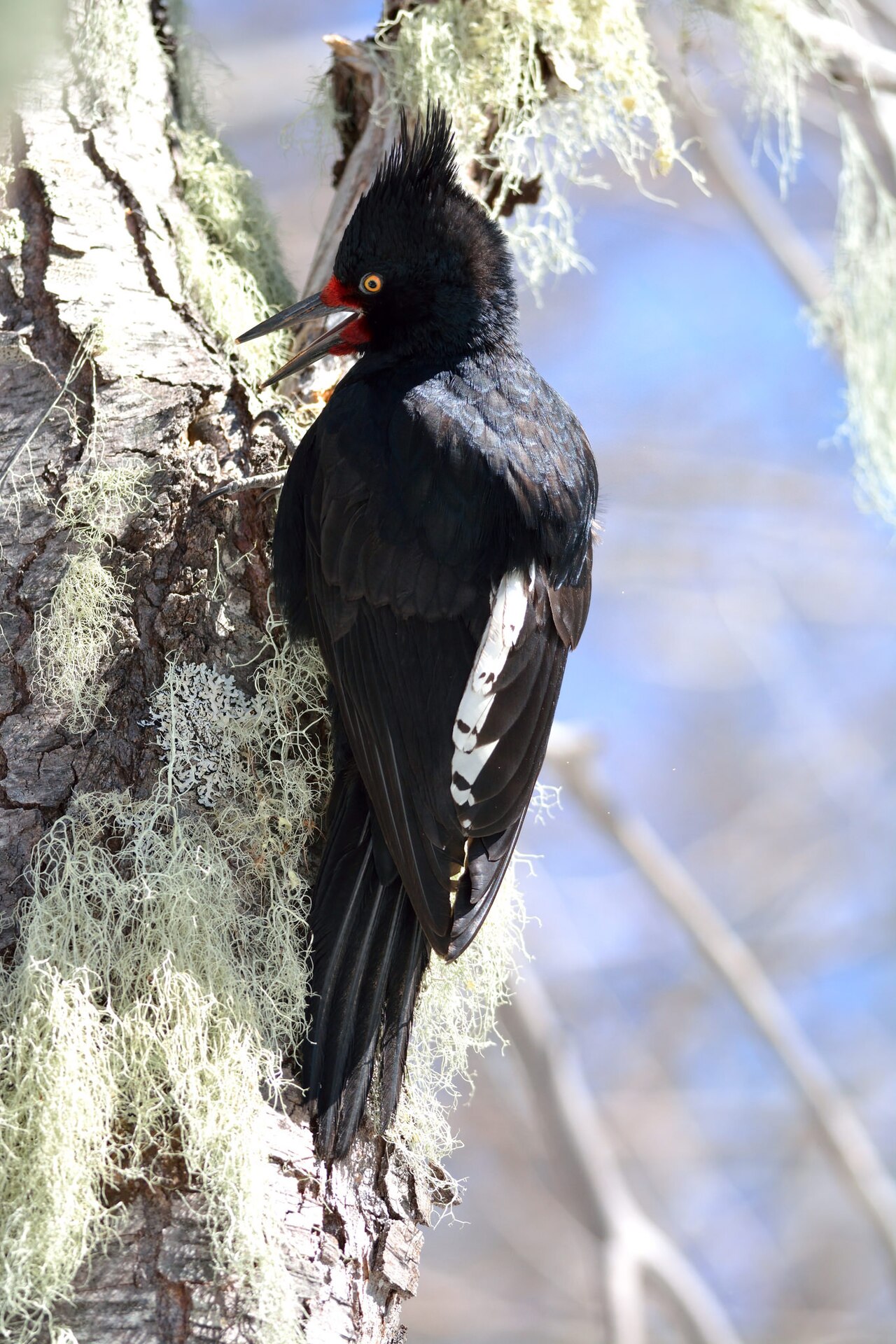
Magellanic woodpecker, female

Magellanic woodpecker, male

Magellanic woodpecker female
Temperament
solitary and territorial
Flight Pattern
strong, bounding flight with short glides
Social Behavior
Usually seen in pairs or small family groups that hold year-round territories. Monogamous pairs excavate large cavity nests in dead or decaying trunks, typically raising 1–2 chicks. Juveniles may accompany parents for several months while learning foraging routes.
Migratory Pattern
Resident
Song Description
Vocalizations include sharp, ringing kiks and a descending, whinny-like series. Drumming is resonant and often preceded or accompanied by a characteristic double-knock used for long-distance communication.
Plumage
Predominantly black with bold white scapular patches forming a wedge on the upper back; white visible in the wings in flight. Males have an entirely red head and pointed crest; females have a black crested head with a clean white malar stripe. Bill is long, pale and chisel-tipped.
Diet
Primarily feeds on wood-boring beetle larvae, carpenter ants, and other insect larvae extracted from decaying wood. It pries bark, excavates deep galleries, and hammers into large limbs and trunks to reach prey. Occasional fruits and other arthropods are taken when available.
Preferred Environment
Forages on standing dead trees, large snags, decaying logs, and thick-barked live trees within mature beech forests. Often works mid to upper trunks but will also feed on large fallen logs and stumps.


