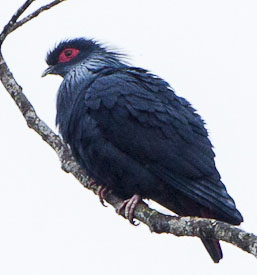
MacGregor's honeyeater, also known as giant wattled honeyeater, MacGregor's giant honeyeater, MacGregor's bird of paradise, and ochre-winged honeyeater, is a large black crow-like bird with large orange-yellow eye-wattles and black-tipped, ochre primary wing feathers. The sexes are similar, with the male being slightly larger than the female. It is the only member of the genus Macgregoria.
Region
New Guinea Highlands
Typical Environment
Occurs along the central cordillera of New Guinea in Papua New Guinea and Indonesian Papua. It inhabits mossy montane forest, cloud forest, and subalpine shrublands near the tree line, often where rhododendrons and pandanus are abundant. The species favors forest edges, gaps, and flowering/fruiting shrubs but also moves through the upper canopy. It is generally local but can be fairly common where habitat is intact.
Altitude Range
2500–3900 m
Climate Zone
Highland
Ease of Keeping
Beginner friendly: 1/5
MacGregor's honeyeater is a large, crow-like honeyeater of New Guinea’s high mountains, notable for its bright orange-yellow eye-wattles and ochre-tinted primaries. It was long considered a bird-of-paradise but is now placed among the honeyeaters (Meliphagidae). The sexes look similar, with males slightly larger. It is the sole member of the genus Macgregoria.

Temperament
shy and wary
Flight Pattern
strong, direct flier with steady wingbeats; occasional short glides downslope
Social Behavior
Usually encountered singly, in pairs, or small family groups. It forages methodically along ridgelines and forest edges, moving between flowering shrubs and fruiting trees. Nesting is presumed to be a cup in a tree or dense shrub, with breeding timed to local resource peaks.
Migratory Pattern
Resident
Song Description
Vocalizations include deep, crow-like croaks interspersed with clear, mellow whistles. Calls carry well across open ridges and subalpine scrub, often given from elevated perches.
Plumage
Uniformly glossy black, crow-like plumage with ochre primary feathers that show as an ochre wing panel edged with black tips. Feathers are sleek with minimal patterning elsewhere. Large, fleshy eye-wattles are conspicuously orange-yellow.
Diet
Takes nectar from blossoms, especially high-montane shrubs such as rhododendrons. Also eats fruits and berries when available. Supplements its diet with insects and other small arthropods gleaned from foliage and bark.
Preferred Environment
Feeds along forest edges, clearings, and subalpine scrub where flowering and fruiting plants are concentrated. Often works the mid- to upper canopy and moves between ridgeline shrubs and adjacent mossy forest.