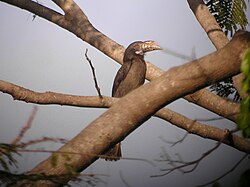
The Luzon hornbill, sometimes called Luzon tarictic hornbill, is a species of hornbill in the family Bucerotidae. It is endemic to forests on Luzon and nearby islands in the northern Philippines. All five Philippine tarictics were once considered a single species. It is declining due to habitat destruction, hunting and the illegal wildlife trade.
Region
Northern Philippines (Luzon group)
Typical Environment
Occurs in primary and mature secondary lowland to foothill forests on Luzon and nearby islands such as Polillo and Catanduanes. It favors intact canopy but will use edges and selectively logged forest where large fruiting trees persist. Often follows seasonal availability of figs and other fruiting trees. Frequents ridges, riverine forest, and forested limestone where cavities are available for nesting.
Altitude Range
Sea level to 1500 m
Climate Zone
Tropical
Ease of Keeping
Beginner friendly: 1/5
The Luzon hornbill is a small tarictic hornbill endemic to Luzon and nearby islands in the northern Philippines. Males are pale below while females are mostly dark, a striking sexual dimorphism typical of tarictics. They nest in tree cavities, with the female sealing herself inside while the male provides food through a narrow slit. As major seed dispersers, especially of figs, they play a key role in forest regeneration.



Temperament
social and active
Flight Pattern
strong flier with rapid wingbeats and short glides
Social Behavior
Typically found in pairs or family parties, sometimes joining small mixed flocks at fruiting trees. Strong pair bonds; the female seals herself inside a tree cavity for nesting while the male provisions her and the chicks. After fledging, family groups may remain together for some time.
Migratory Pattern
Resident
Song Description
Vocalizations include loud cackles, chattering notes, and grunting calls, often delivered from the canopy. The heavy wingbeats produce a distinctive whooshing sound in flight.
Plumage
Male with creamy-buff head, neck, and underparts contrasting with blackish upperparts; female largely dark with black head and underparts. Both sexes show a small casque on a curved bill and a pale tail with darker subterminal band.
Diet
Primarily feeds on fruits, especially figs (Ficus), drupes, and other lipid-rich berries. Also takes small invertebrates and occasionally small vertebrates, particularly when feeding chicks. Regurgitates seeds intact and disperses them across the forest, aiding regeneration. Will travel between fruiting trees and can be faithful to productive patches.
Preferred Environment
Forages high in the canopy at large fruiting trees, but will descend to mid-story when fruit is abundant. Uses forest edges and along rivers where fruit resources can be concentrated.