

The large-billed tern is a species of tern in the family Laridae. It is placed the monotypic genus Phaetusa. It is found in most of South America. It has occurred as a vagrant in Aruba, Bermuda, Cuba, Panama and the United States. Its natural habitats are rivers and freshwater lakes.
Region
South America
Typical Environment
This species inhabits major lowland river systems including the Amazon, Orinoco, and Paraguay–Paraná basins, as well as large lakes, oxbow lakes, and reservoirs. It is strongly tied to broad channels with exposed sandbars and beaches, especially during the dry season. While primarily inland, it may occur in estuaries and coastal lagoons locally. It is widespread from Colombia and Venezuela through the Guianas, Peru, Bolivia, much of Brazil, Paraguay, and northern Argentina, with occasional vagrants reaching the Caribbean and southern United States.
Altitude Range
0–1200 m
Climate Zone
Tropical
Ease of Keeping
Beginner friendly: 1/5
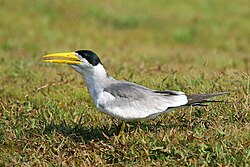
The large-billed tern is the sole member of the genus Phaetusa and is instantly recognized by its long, thick yellow bill. It favors wide tropical rivers and sandbars across much of South America. Nesting occurs on exposed riverine sandbanks where its eggs and chicks rely on camouflage and open sightlines rather than cover. It often forms loose colonies and readily follows changing water levels across seasons.




Temperament
social and active
Flight Pattern
strong flier with buoyant, agile wingbeats
Social Behavior
Often seen in small groups or loose colonies, especially on sandbars where it roosts and nests. Nests are simple scrapes on bare sand or gravel, typically in open areas. Both parents participate in incubation and chick rearing, and adults show vigorous defensive displays against intruders.
Migratory Pattern
Partial migrant
Song Description
Vocalizations are sharp, rasping, and scolding, often given in flight over colonies or feeding areas. Calls carry well across open water and sandbars and are used to coordinate group movements and alarm responses.
Plumage
Smooth pale grey upperparts with clean white underparts and a sharply contrasting black cap; wings show darker outer primaries. Tail is deeply forked. In nonbreeding plumage, the forehead can appear paler.
Diet
Primarily small fish taken by shallow plunge-diving or surface-dipping. It also captures aquatic insects and occasionally small crustaceans. Foraging is opportunistic, with birds patrolling low over the water and making quick, direct strikes. The large, deep bill aids in seizing slippery prey near the surface.
Preferred Environment
Feeds over broad river channels, along the edges of sandbars, and in quiet backwaters or oxbow lakes. It may also forage above reservoirs and estuarine lagoons where visibility is good and prey concentrates near the surface.


