

The Lapland longspur, also known as the Lapland bunting, is a passerine bird in the longspur family Calcariidae, a group separated by most modern authors from the Fringillidae.
Region
Arctic and Subarctic
Typical Environment
Breeds across the circumpolar tundra of northern Europe, Russia, Alaska, and northern Canada. In winter it moves to more temperate open habitats including prairies, stubble fields, coastal dunes, and shores across Eurasia and North America. During migration it uses open agricultural lands, grasslands, and sparsely vegetated coastal margins. It favors broad, treeless expanses with low vegetation and patches of bare ground.
Altitude Range
Sea level to 2000 m
Climate Zone
Polar
Ease of Keeping
Beginner friendly: 1/5
Also called the Lapland bunting, this longspur breeds on Arctic tundra across Eurasia and North America and winters much farther south in open fields and coasts. Males transform from a streaky, cryptic nonbreeding look to a striking breeding plumage with a black face and breast and a rich chestnut nape. They often form large, mixed winter flocks with snow buntings and horned larks. The species is named for Lapland, the far‑northern region of Fennoscandia.


Sitting on a dead cow parsnip, Buldir Island, Alaska


Temperament
social and active
Flight Pattern
short rapid wingbeats with bounding, undulating flight
Social Behavior
Forms large flocks in winter, often mixing with other open-country songbirds. On the breeding grounds pairs are territorial, nesting on the ground in shallow, grass-lined cups concealed in tundra vegetation. Females incubate while males stand guard and deliver food; both parents feed the young. Displays include aerial song flights over the territory.
Migratory Pattern
Seasonal migrant
Song Description
The song is a sweet, tinkling series of clear notes and soft trills delivered from a perch or in fluttering display flight. Calls include dry rattles and metallic chips that carry over open ground. Flock contact calls are sharp and distinctive in flight.
Plumage
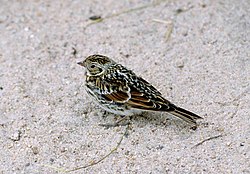
Breeding males show a black face and breast with a crisp white throat and belly, a rich chestnut nape, and streaked brown upperparts; nonbreeding birds are more buffy and heavily streaked, masking the black areas. Females and juveniles are streaky brown overall with pale underparts. All ages have white outer tail feathers and a noticeably long hind claw (the 'longspur').
Diet
In winter it feeds mainly on grass and weed seeds, grains, and small buds picked from the ground or low plants. During the breeding season it switches to insects and other arthropods such as beetles, flies, caterpillars, and spiders to meet protein demands for nestlings. It also gleans from snow-free patches and along melt edges in spring. Grit is taken to aid seed digestion.
Preferred Environment
Feeds in open tundra with short sedges and dwarf shrubs during summer. In migration and winter it favors agricultural fields, stubble, pastures, coastal dunes, and sparsely vegetated shorelines, usually foraging on bare or lightly vegetated ground. Often works in tight flocks that move collectively across feeding areas.


