The kori bustard is the largest flying bird native to Africa. It is a member of the bustard family, which all belong to the order Otidiformes and are restricted in distribution to the Old World. It is one of the four species in the large-bodied genus Ardeotis. The male kori bustard may be the heaviest living animal capable of flight.
Region
Eastern and Southern Africa
Typical Environment
Occurs patchily from Ethiopia and Kenya south through Tanzania to Angola, Namibia, Botswana, Zimbabwe, and South Africa. It favors open to lightly wooded savannas, arid grasslands, and thorn scrub with scattered trees. The species avoids dense forests and steep mountains but uses agricultural edges and burnt areas where prey is abundant. Protected areas such as the Serengeti, Etosha, and the Kalahari support important populations.
Altitude Range
Sea level to 2000 m
Climate Zone
Arid
Ease of Keeping
Beginner friendly: 1/5
The kori bustard is among the heaviest living birds capable of sustained flight, with large males sometimes exceeding 15 kg. It spends most of its time walking and is reluctant to fly unless disturbed. Males perform dramatic courtship displays, inflating the neck and fanning the tail while emitting deep booming calls. They are sometimes accompanied by carmine bee-eaters that hawk insects flushed by the bustard’s footsteps.


A C. G. Finch-Davies illustration (1912)

A kori bustard is tall enough to feed from shrubs and small trees from the ground.

A kori bustard in Kgalagadi Transfrontier Park

A. k. struthiunculus in Amboseli, Kenya

A close-up of the plumage of a captive male

Ardeotis kori kori flying near Windhoek, Namibia. They are arguably the largest or one of the largest extant flying animals.

Female of the nominate race near Etosha National Park, Namibia

A kori bustard taking a dust or sand bath

A kori bustard feeding in grassy area
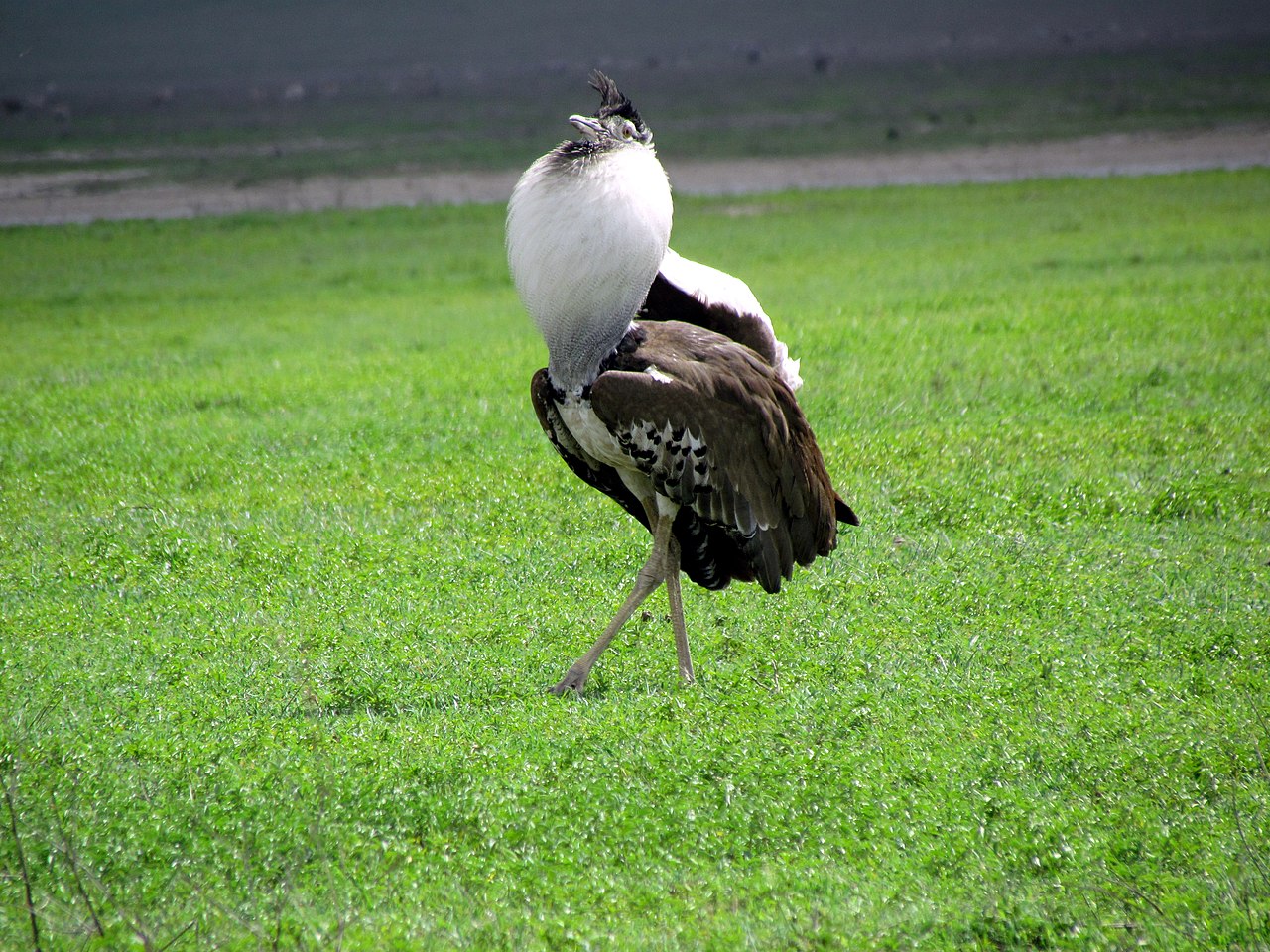
Male kori bustard (A. k. struthiunculus) displaying in Ngorongoro Conservation Area

Egg, Collection Museum Wiesbaden
![Chick in the Kgalagadi Transfrontier Park. A chick travels with its mother for more than a year, and may cover a kilometre a day while she rears it on grasshoppers and beetles.[30]](https://upload.wikimedia.org/wikipedia/commons/thumb/0/0b/Kori_Bustard_%28Ardeotis_kori%29_chick_..._%2845344367474%29.jpg/1280px-Kori_Bustard_%28Ardeotis_kori%29_chick_..._%2845344367474%29.jpg)
Chick in the Kgalagadi Transfrontier Park. A chick travels with its mother for more than a year, and may cover a kilometre a day while she rears it on grasshoppers and beetles.[30]
![Shock display of A. kori kori at Pilanesberg Game Reserve – the head is lowered, the wings are opened with their upper surface angled forward, and the tail is raised and fanned.[30]](https://upload.wikimedia.org/wikipedia/commons/thumb/a/a7/Kori_bustard%2C_Ardeotis_kori%2C_at_Pilanesberg_National_Park%2C_Northwest_Province%2C_South_Africa_%2816761001470%29.jpg/960px-Kori_bustard%2C_Ardeotis_kori%2C_at_Pilanesberg_National_Park%2C_Northwest_Province%2C_South_Africa_%2816761001470%29.jpg)
Shock display of A. kori kori at Pilanesberg Game Reserve – the head is lowered, the wings are opened with their upper surface angled forward, and the tail is raised and fanned.[30]

A kori bustard walking near a leopard, seemingly ignoring one another

Richard Meinertzhagen holds a shot kori bustard near Nairobi in 1915, illustrating the bird's huge size.

Southern kori bustard (A. k. kori), killed by overhead line collision.
Temperament
solitary and wary
Flight Pattern
reluctant flier with slow, powerful wingbeats; usually flushes only when pressed
Social Behavior
Generally solitary or in small loose groups; males are polygynous and display on open ground to attract females. A simple ground scrape serves as the nest, and the precocial chick is mobile soon after hatching. Nonbreeding birds may aggregate where food is concentrated.
Migratory Pattern
Partial migrant
Song Description
Mostly quiet, but males produce deep, resonant booms and grunts during courtship displays. Both sexes may utter low growls and clucks when alarmed or communicating at close range.
Plumage
Heavily mottled sandy-brown upperparts with fine vermiculations, pale underparts, and a barred tail; neck finely streaked with a contrasting pattern. Flight reveals striking black-and-white flight feathers and wing panels.
Diet
An opportunistic omnivore feeding on large insects such as locusts, grasshoppers, and beetles, as well as small reptiles, rodents, and the occasional chick of ground-nesting birds. It also takes seeds, berries, and other plant matter, and will scavenge carrion. Grit and small stones are swallowed to aid in grinding food.
Preferred Environment
Forages by walking slowly in open savanna, short grass, burned patches, and along the margins of scrub. Often exploits termite emergences and areas with recent rainfall where invertebrates are abundant.