

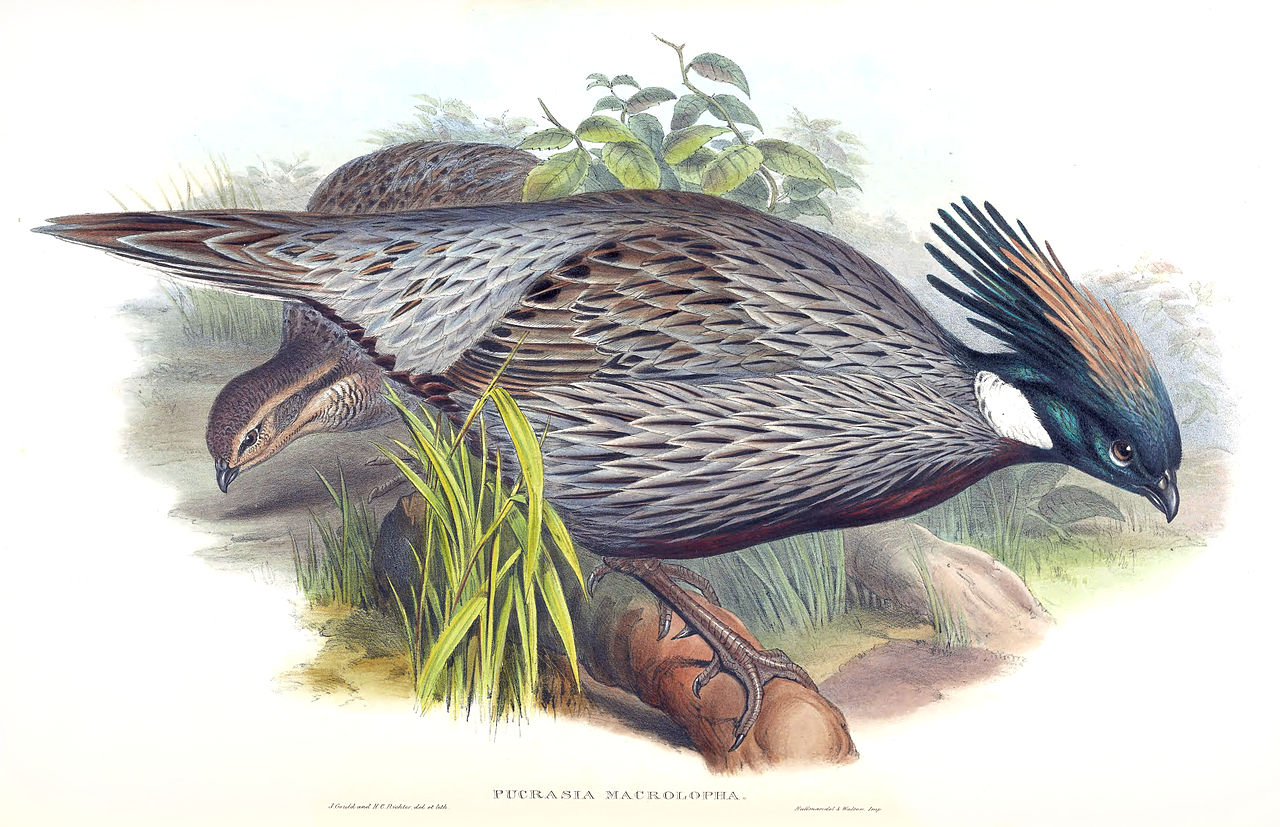
The koklass pheasant is a species of gamebird, being closely related to progenitive grouse that lived during the Miocene. They are distantly related to pheasants and are most closely related to grouse and turkeys. Koklass are the only species in the monotypic genus Pucrasia. Both the words koklass and pucrasia have been onomatopœically derived from the bird's territorial call.
Region
Himalayas and northern China
Typical Environment
Found from northern Pakistan and India through Nepal and Bhutan to the eastern Himalayas, and across central to northern China. It inhabits temperate broadleaf and mixed conifer forests with dense undergrowth, including oak, pine, fir, and rhododendron. Steep, forested slopes, ravines, and thickets are favored, and it avoids extensive open country. Birds often descend to lower elevations in winter and move upslope to breed in summer.
Altitude Range
1500–4000 m
Climate Zone
Highland
Ease of Keeping
Beginner friendly: 2/5
The koklass pheasant is the sole member of the genus Pucrasia and is more closely related to grouse and turkeys than to true pheasants. Its name, as well as the genus name, is onomatopoeic, echoing the male’s ringing territorial call. Unlike many galliforms, koklass are often monogamous and make seasonal altitudinal movements in mountainous forests.


P. m. xanthospila

Female koklass pheasant (Pucrasia macrolopha)


Temperament
shy and elusive
Flight Pattern
short rapid wingbeats with brief glides
Social Behavior
Usually seen singly or in pairs, forming small family parties after breeding. Generally ground-dwelling, it roosts in trees and nests on the ground, concealed under dense cover. Courtship involves calling from perches and displaying the crest; pairs are often monogamous within a season.
Migratory Pattern
Partial migrant
Song Description
The male’s territorial call is a ringing, accelerating series often rendered as “kok-kok-kok-laas,” carrying far across valleys. Contact and alarm calls are harsher clucks and cackles, with loud wing-whirring during sudden flushes.
Plumage
Male finely vermiculated brown and olive with a striking black face and white throat, plus a long contrasting black-and-white crest; female cryptically mottled brown with fine barring. Both sexes show patterned upperparts and a relatively long, square-ended tail.
Diet
Omnivorous, taking buds, shoots, leaves, roots, seeds, and berries, especially from oak and rhododendron understory. It also consumes insects, larvae, and other small invertebrates, particularly in the breeding season. Birds scratch through leaf litter and can dig through light snow to reach food in winter.
Preferred Environment
Forages on the forest floor in dense undergrowth, along edges, clearings, and forested ravines. Often feeds near fallen logs, thickets, and along trails or stream banks where cover is close.


