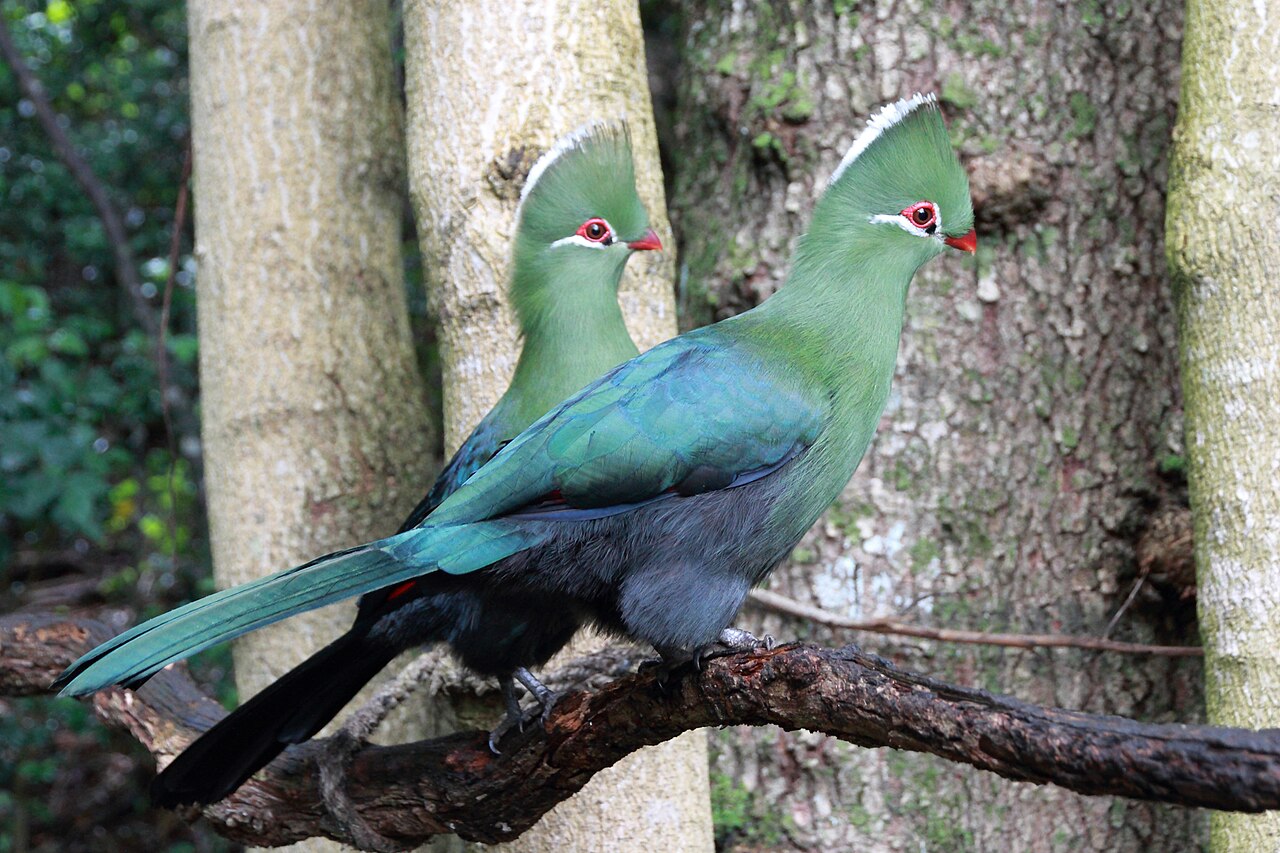
The Knysna turaco, or, in South Africa, Knysna loerie, is a large turaco, one of a group of African musophagidae birds. It is a resident breeder in the mature evergreen forests of southern and eastern South Africa, and Eswatini. It was formerly sometimes considered to be a subspecies of the green turaco of West Africa. The Livingstone's and Schalow's turacos were once considered subspecies.
Region
Southern Africa
Typical Environment
Found in mature evergreen (Afromontane) and coastal forests, riverine woodland, and dense thickets of southern and eastern South Africa and Eswatini. It keeps to mid- to upper-canopy levels, often along forest edges where fruiting trees are abundant. Birds may venture into large gardens and orchards adjoining forest. They are largely sedentary, with local movements tracking seasonal fruit availability.
Altitude Range
Sea level to 1800 m
Climate Zone
Subtropical
Ease of Keeping
Beginner friendly: 2/5
Also called the Knysna loerie, this turaco is famous for its brilliant crimson primary feathers that flash during flight. It lives in evergreen and riverine forests of southern and eastern South Africa and Eswatini, moving nimbly through the canopy. Its vivid green plumage comes from true pigments (turacoverdin), rare among birds. Pairs maintain territories and often duet with loud, barking calls.


Temperament
shy yet agile, often secretive in dense foliage
Flight Pattern
short rapid wingbeats with gliding bursts; conspicuous crimson wing flash
Social Behavior
Usually seen in pairs or small family groups. Monogamous pairs defend territories within forest patches. Nest is a flimsy platform hidden in dense foliage; both parents incubate and feed chicks by regurgitation.
Migratory Pattern
Resident
Song Description
Loud, resonant barking and hooting notes often rendered as kow-kow or ko-waah, carrying far through forests. Calls are frequently given in duets at dawn and dusk and during territorial interactions.
Plumage
Rich green body and crest with a dark bluish tail; wings dark with brilliant crimson primaries visible in flight. Face shows bold white lines before and after the eye and a red orbital ring. Plumage has a silky sheen, especially on the crest and mantle.
Diet
Primarily frugivorous, favoring figs and other soft fruits, but also taking berries and cultivated fruits when available. Supplements diet with buds, young leaves, and flowers. Occasionally ingests small invertebrates incidentally while foraging among foliage.
Preferred Environment
Forages in the mid- to upper canopy of evergreen and riverine forests, often along edges and clearings where fruiting trees are concentrated. Will visit gardens and orchards adjacent to forests during peak fruiting.