

The Juan Fernández firecrown is a critically endangered hummingbird in the "coquettes", tribe Lesbiini of subfamily Lesbiinae. It is endemic to Isla Róbinson Crusoe, one of the three-island Juan Fernández archipelago belonging to Chile.
Region
Juan Fernández Archipelago, Southeast Pacific
Typical Environment
Restricted to Robinson Crusoe Island, it uses native forests, shrublands, ravines, and human-influenced areas near the settlement of San Juan Bautista. It prefers flowering native vegetation but also visits introduced ornamentals in gardens. The species forages along forest edges and in sheltered valleys where nectar sources are abundant. Breeding territories are often centered on dense patches of flowering shrubs and trees.
Altitude Range
Sea level to 600 m
Climate Zone
Subtropical
Ease of Keeping
Beginner friendly: 1/5
The Juan Fernández firecrown is a critically endangered hummingbird found only on Isla Róbinson Crusoe, Chile. Males are strikingly cinnamon-rufous with a fiery iridescent crown, while females are mostly green above with pale underparts, making the species highly sexually dimorphic. Habitat loss, invasive species, and competition for nectar threaten its survival. Conservation efforts focus on habitat restoration and controlling invasive plants and predators.


Adult female drawn from a millinery specimen
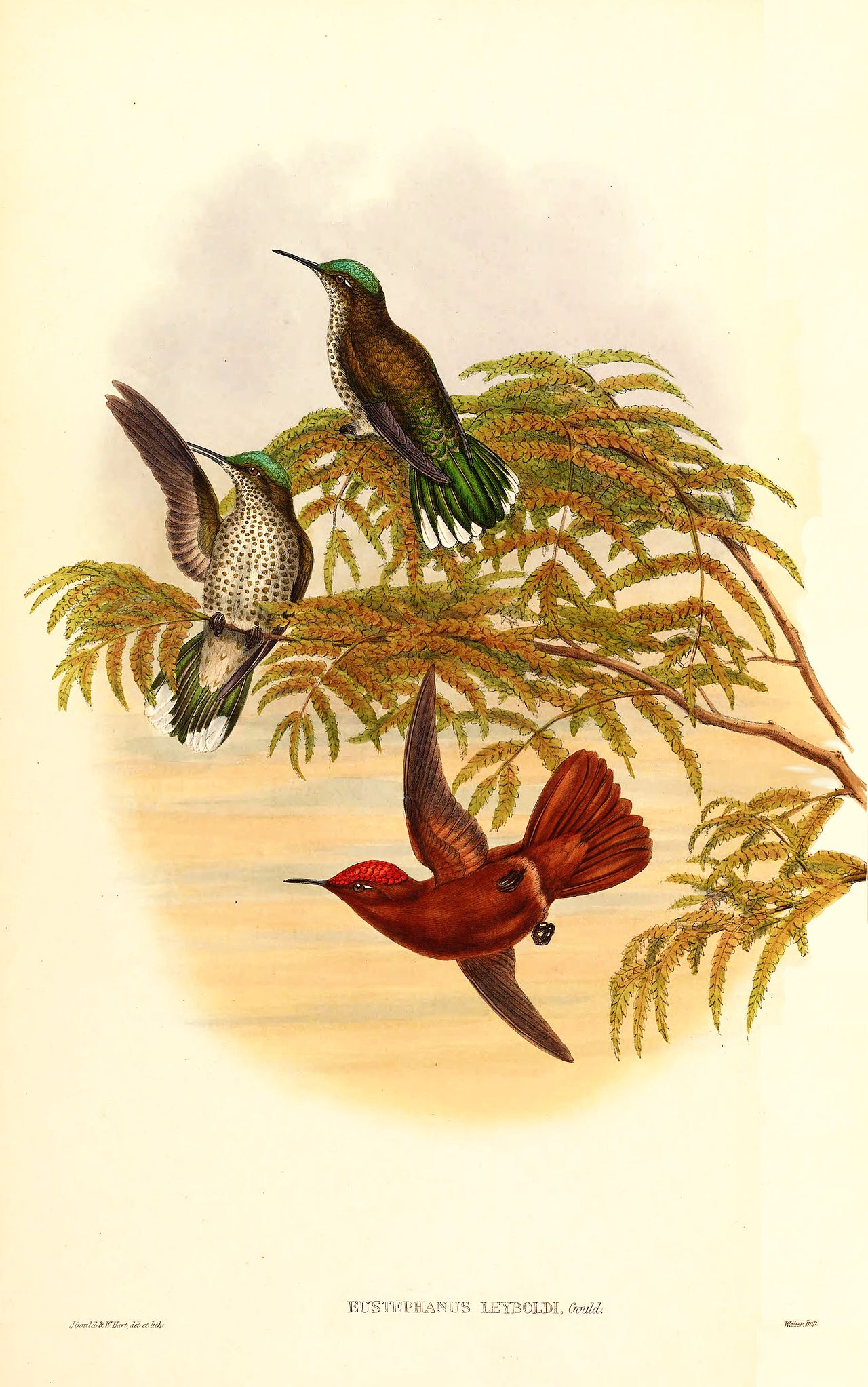
The putative extinct subspecies S. f. leyboldi

Temperament
solitary and territorial
Flight Pattern
rapid hovering and darting flight with short, swift sallies
Social Behavior
Typically solitary outside the breeding season, with males defending rich nectar patches aggressively. Courtship involves aerial chases and displays near favored flowers. The female builds a small cup nest alone, incubates, and raises 1–2 chicks without male assistance.
Migratory Pattern
Resident
Song Description
Calls include sharp chips and buzzes, with rapid chattering during aggressive encounters. Wing hum is prominent during close-range displays and foraging.
Plumage
Male is overall bright cinnamon-rufous with a showy, iridescent crown forming a spiky 'firecrown.' Female is green above with whitish underparts marked with greenish spotting and a contrasting, iridescent crown patch.
Diet
Primarily feeds on nectar from native shrubs and trees, supplementing with introduced garden flowers when available. Also consumes small insects and spiders for protein, especially during breeding. It hawks tiny arthropods in flight and occasionally gleans them from foliage.
Preferred Environment
Forages along forest edges, in sheltered ravines, and within gardens where flowering plants are concentrated. Often returns repeatedly to productive nectar patches and defends them vigorously.


