
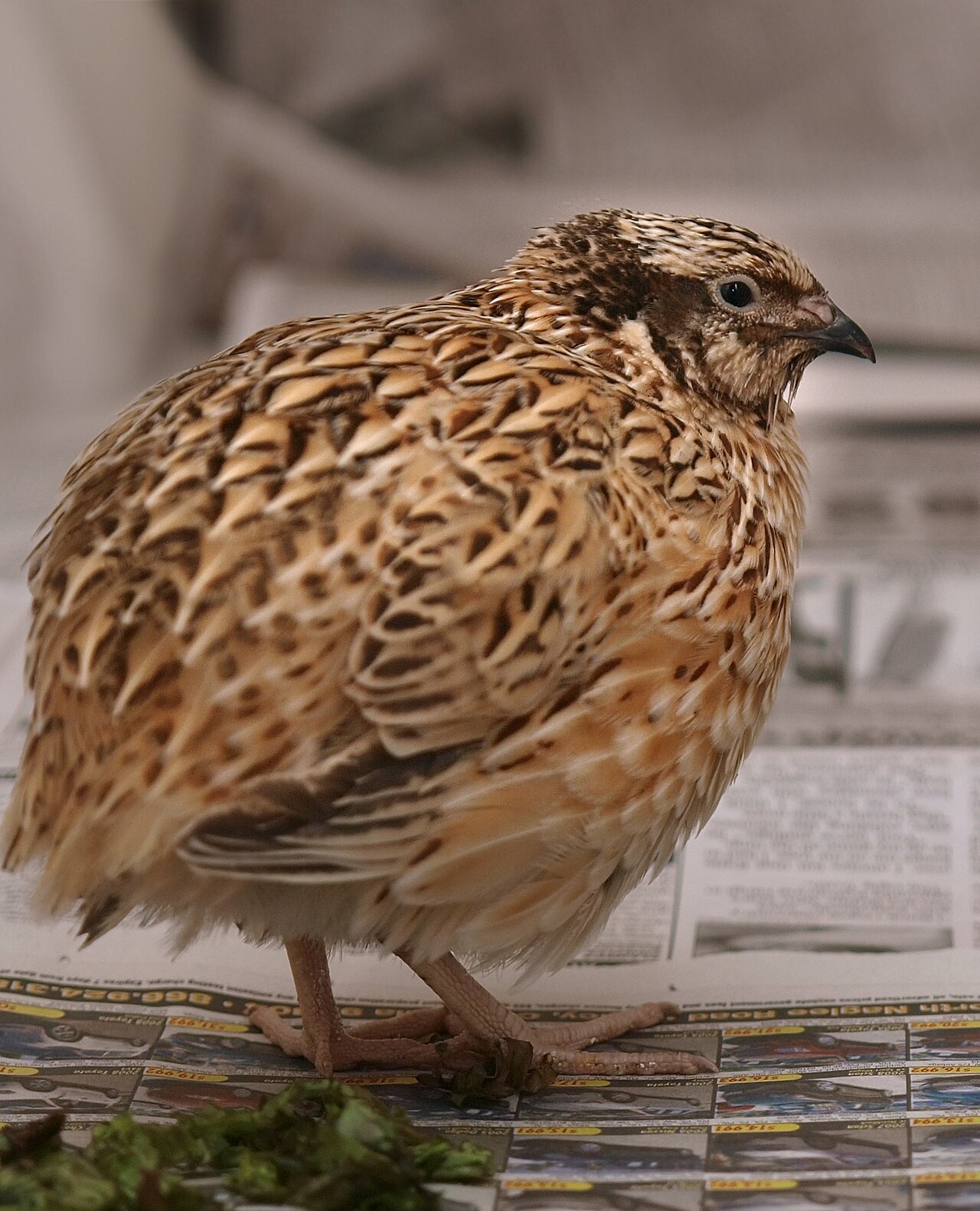
The Japanese quail, also known as the coturnix quail, is a species of Old World quail found in East Asia. First considered a subspecies of the common quail, it is now considered as a separate species. The Japanese quail has played an active role in the lives of humanity since the 12th century, and continues to play major roles in industry and scientific research. Where it is found, the species is abundant across most of its range. Currently, there are a few true breeding mutations of the Japanese quail. The varieties currently found in the United States include Pharaoh, Italian, Manchurian, Tibetan, Rosetta, along with the following mutations: sex-linked brown, fee, roux, silver, andalusian, blue/blau, white winged pied, progressive pied, albino, calico, sparkly, as well as non-color mutations such as celadon.
Region
East Asia
Typical Environment
In the wild, Japanese quail inhabit open grasslands, meadows, scrub, and agricultural landscapes such as rice paddies and stubble fields. They prefer areas with dense ground cover for nesting and protection, often near water and field margins. During non-breeding seasons they use fallow fields and weedy edges extensively. Domesticated birds occur worldwide in captivity, particularly in farms and research facilities.
Altitude Range
0–2000 m
Climate Zone
Temperate
Ease of Keeping
Beginner friendly: 4/5
Japanese quail mature rapidly (often laying by 6–8 weeks) and are prolific egg layers, which makes them important in agriculture and research. Their eggs are widely used in cuisine, and the species serves as a model organism in developmental biology and toxicology. Wild populations are migratory ground-dwellers, while domesticated strains include many color mutations. They are generally hardy, compact birds that adapt well to managed environments.


Japanese quail in Yehliu, Taiwan

Drawing of the head of a Japanese quail

Normal color Japanese quail egg and white Japanese quail egg

Newly hatched Japanese quail

Japanese quail after 7 days (left) and king quail after 20 days (right)

Quail eggs on sale in Coimbatore, India

Quail eggs as a side dish at a Japanese izakaya
Temperament
social but skittish; settles with gentle handling in captivity
Flight Pattern
short rapid wingbeats with explosive take-off; low, direct flights
Social Behavior
Typically forms small groups outside the breeding season and remains closely tied to ground cover. Nests are shallow scrapes lined with vegetation, with clutches commonly 6–12 eggs; incubation lasts about 16–18 days. Mating systems vary, but in the wild birds are generally secretive and ground-oriented.
Migratory Pattern
Seasonal migrant
Song Description
Males give a clear, repetitive crowing call, often rendered as a sharp, whistled 'kwa-kwa-kee'. Contact calls are soft chirps and trills used to maintain group cohesion. Alarm calls are abrupt and high-pitched.
Plumage
Compact, streaked brown and buff plumage with dark mottling; females are more heavily streaked and cryptic. Males often show a warmer rufous breast and face with less streaking. The crown is lined with darker stripes and a paler supercilium is usually visible.
Diet
Feeds on a mix of grass and weed seeds, grains, and green plant matter, supplemented with insects such as beetles, ants, and small grasshoppers. Chicks are more insectivorous, shifting to more seeds as they mature. In agricultural settings they readily consume spilt grain and weed seeds, providing incidental pest control.
Preferred Environment
Forages on the ground in fields, stubble, and grassy margins, often under low cover. Uses edges of rice paddies, fallow plots, and weedy patches where seeds and invertebrates are abundant.


