

The hoopoe starling, also known as the Réunion starling or Bourbon crested starling, is a species of starling that lived on the Mascarene island of Réunion and became extinct in the 1850s. Its closest relatives were the also-extinct Rodrigues starling and Mauritius starling from nearby islands, and the three apparently originated in south-east Asia. The bird was first mentioned during the 17th century and was long thought to be related to the hoopoe, from which its name is derived. Some affinities have been proposed, but it was confirmed as a starling in a DNA study.
Region
Mascarene Islands, western Indian Ocean
Typical Environment
Endemic to Réunion, it inhabited native lowland and montane forests and forest edges. Early accounts suggest it used wooded ravines, ridges, and secondary growth where it could forage among foliage and bark. It likely tolerated some disturbed habitats and may have entered orchards and clearings to exploit seasonal fruit. The species was probably most frequent where mature trees provided cavities for nesting and ample invertebrate prey.
Altitude Range
Sea level to 1800 m
Climate Zone
Tropical
Ease of Keeping
Beginner friendly: 1/5
Also called the Réunion starling or Bourbon crested starling, it was famous for its long hoopoe-like crest and downcurved bill. It went extinct in the mid-19th century, likely due to habitat loss, hunting, and the impact of introduced predators. Long considered related to hoopoes because of its appearance, DNA later confirmed it was a true starling. Its closest relatives were the extinct starlings of Mauritius and Rodrigues.


The related Bali myna, which is similarly coloured and also has a crest

Only known life drawing, showing the natural position of the crest, by Paul Jossigny, early 1770s

1860s illustration by Albert Roussin


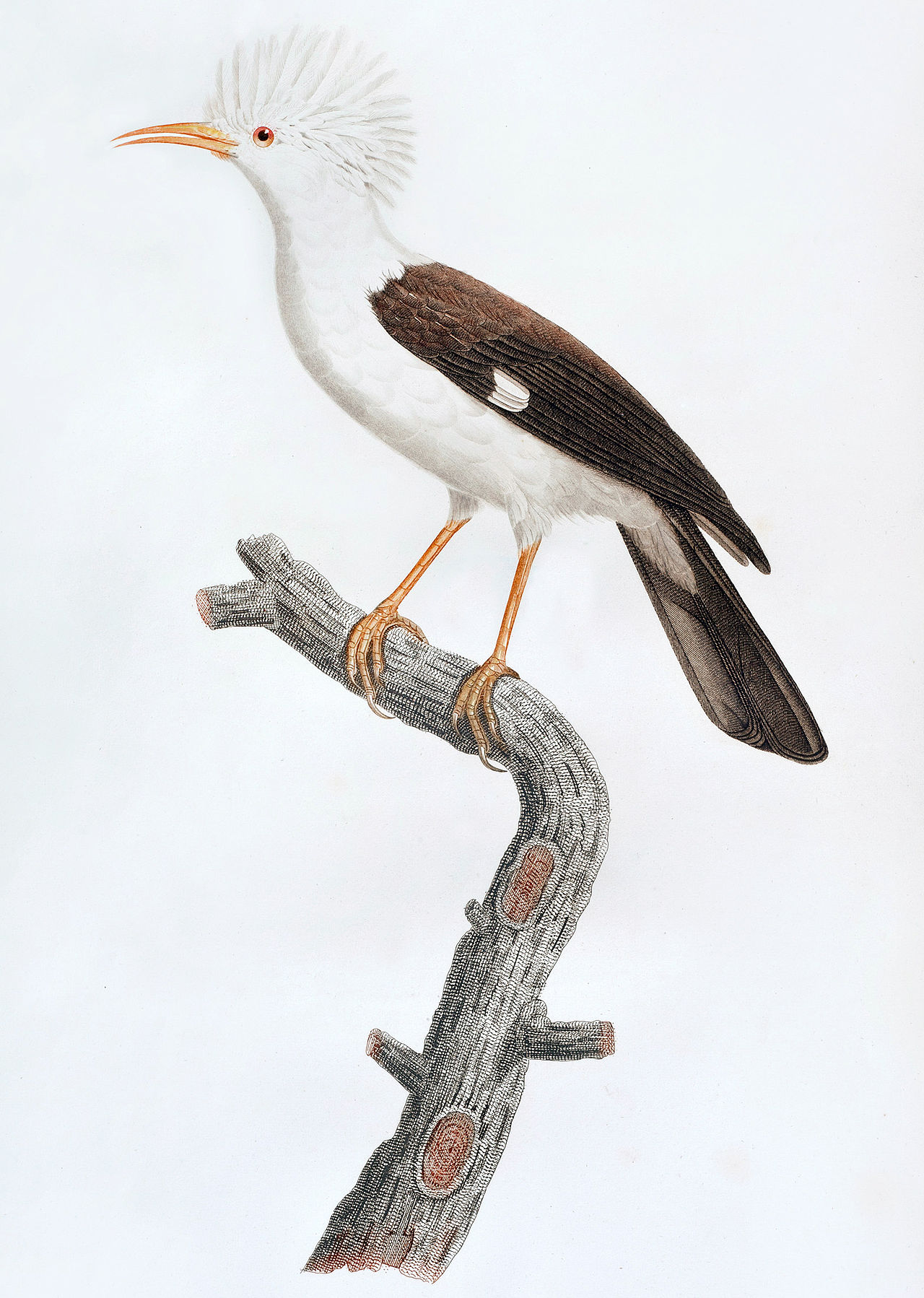
1807 illustration by Jacques Barraband
Temperament
social and active
Flight Pattern
direct flight with short rapid wingbeats
Social Behavior
Reported in pairs or small groups, likely forming loose flocks outside the breeding season as many starlings do. It probably nested in tree cavities or crevices, with both parents helping to rear the young. Courtship may have included crest displays and vocal exchanges.
Migratory Pattern
Resident
Song Description
Described historically as varied, with chatters, whistles, and harsher notes typical of starlings. Calls were likely used for contact within groups and during display.
Plumage
Pale grey to whitish body with darker wings and tail; smooth, sleek contour feathers and a prominent erectile crest.
Diet
An opportunistic omnivore, taking insects, larvae, and other invertebrates gleaned from bark and foliage. It likely supplemented with fruits and berries when available, and may have probed flowers for nectar or arthropods. The long decurved bill was well-suited for probing crevices, moss, and epiphytes.
Preferred Environment
Foraged in forest canopies and mid-story, along edges, and in secondary growth. It also likely fed on the ground or low branches in clearings and along streams where invertebrates were abundant.


