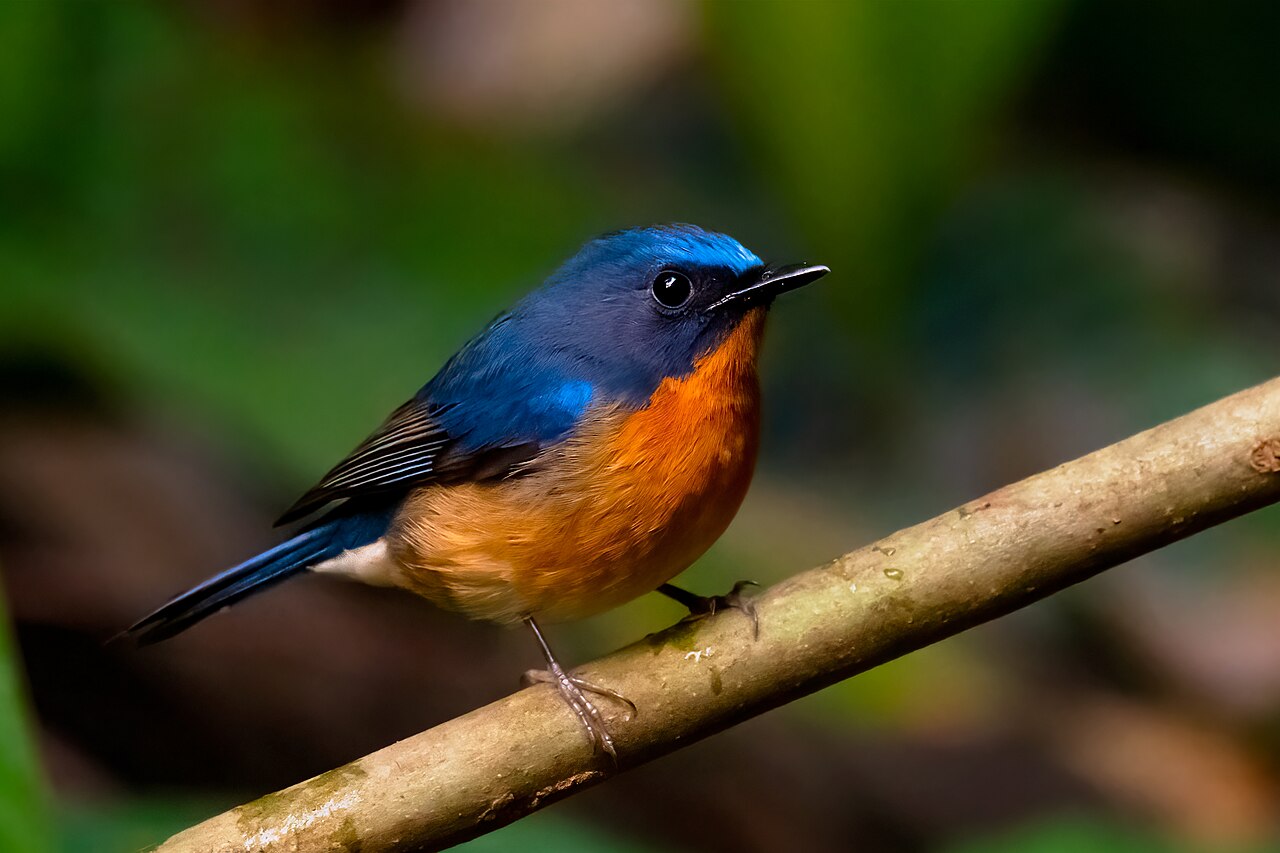
Heuglin's wheatear is a small passerine bird in the wheatear genus Oenanthe.
Region
Northeast Africa
Typical Environment
Occurs from the Sahel eastward through Sudan and South Sudan into Eritrea and Ethiopia, extending into northern Somalia and parts of northern Kenya. Prefers open semi-desert, rocky plains, basalt fields, and dry savanna with scattered acacia. Frequently found on stony slopes, eroded gullies, and along dry riverbeds where perches are available. It favors areas with sparse ground cover for foraging and nearby cavities or crevices for nesting.
Altitude Range
Sea level to 2400 m
Climate Zone
Arid
Ease of Keeping
Beginner friendly: 1/5
Heuglin's wheatear is a small, ground-oriented chat of open, arid country in northeastern Africa. It often perches on rocks or low shrubs, flicking its tail to show a striking white rump and black tail band. The species has sometimes been lumped with Pied Wheatear, but is generally treated as distinct. It adapts well to sparsely vegetated landscapes and uses rock crevices or earthen banks for nesting.

Temperament
solitary and territorial
Flight Pattern
short rapid wingbeats with low, direct flights
Social Behavior
Usually encountered singly or in pairs, especially during the breeding season when it defends territories. Nests are placed in rock crevices, holes in banks, or under stones and are lined with plant fibers. Pairs are monogamous for the season and both adults often attend the nest. Outside breeding, it may be loosely associated with other open-country birds while foraging.
Migratory Pattern
Partial migrant
Song Description
A scratchy, rambling warble interspersed with clearer whistles, delivered from a conspicuous perch or short song-flights. The call is a sharp tchak or chk typical of wheatears. Song can be persistent at dawn during the breeding period.
Plumage
Male typically shows dark to blackish face and throat with contrasting pale to warm-buff underparts, brownish to dark upperparts, and a prominent white rump and tail with a broad black terminal band. Female is sandy-brown above with paler buff underparts and the same wheatear tail pattern. Both sexes show a neat, compact build with upright stance and frequent tail-flicking.
Diet
Primarily feeds on insects such as beetles, ants, termites, grasshoppers, and small flies, as well as spiders and other small arthropods. It hunts by scanning from a low perch and making short sallies to the ground to pounce on prey. Occasionally hawks low-flying insects and will turn over small stones to flush hidden invertebrates. Small amounts of seeds or berries may be taken opportunistically.
Preferred Environment
Forages on bare or sparsely vegetated ground, rocky flats, and along the edges of dry washes and tracks. Uses rocks, termite mounds, and low shrubs as vantage points, moving between perches with quick flights. Often feeds in early successional or overgrazed areas where ground cover is open.