

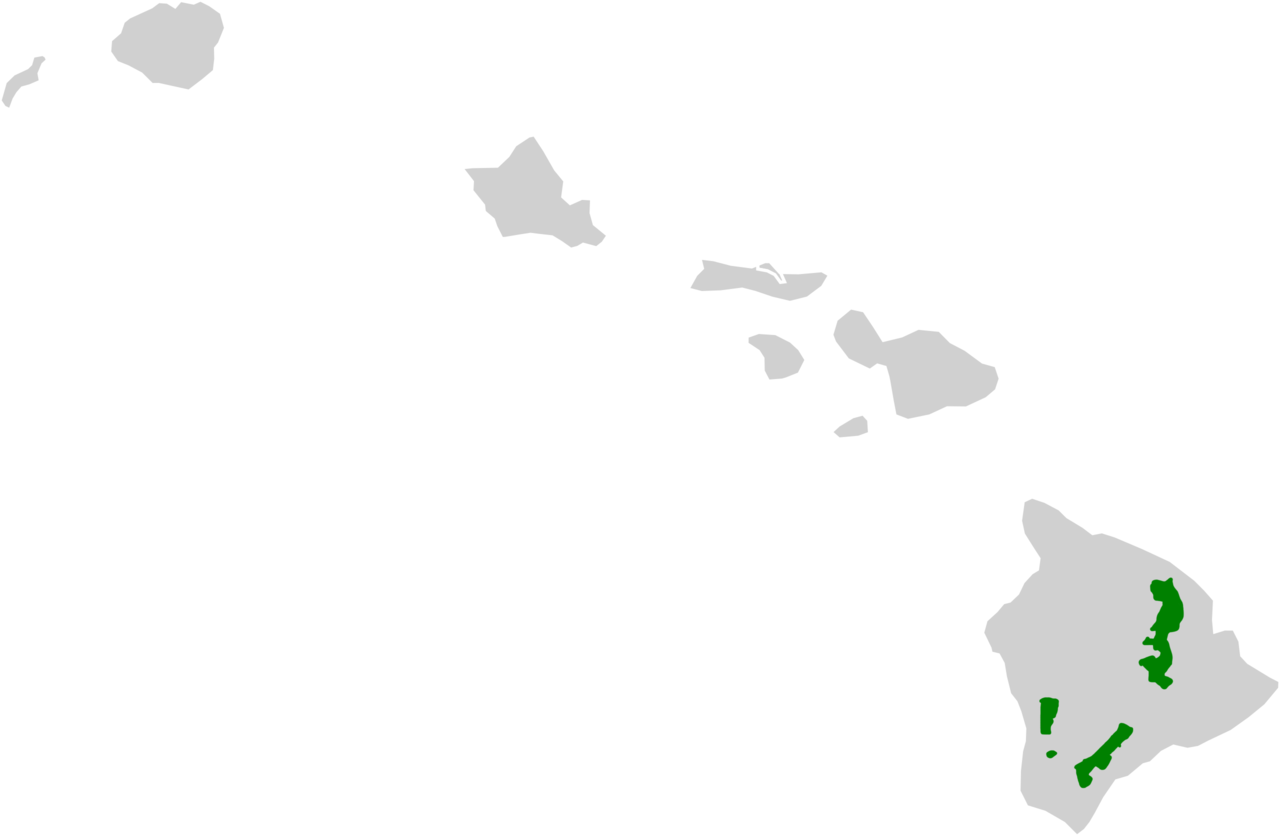
The Hawaiʻi creeper, Hawaii creeper or alawī is a species of Hawaiian honeycreeper endemic to the Big Island of Hawaiʻi. Its natural habitats are dry forests and montane moist forests at elevations of 1,000–2,300 metres (3,300–7,500 ft). There are a total of 12,000 birds separated into three populations. A fourth population on the western part of the island probably represents migratory birds from one of the existing population. The Hawaiʻi creeper measures 4.5 inches (11 cm) and has drab green plumage. In 2017 the traditional Hawaiian name was rediscovered as alawī.
Region
Hawaiʻi Island, Hawaiian Archipelago
Typical Environment
Occurs in native dry to montane wet and mesic forests dominated by ʻōhiʻa lehua (Metrosideros polymorpha) and koa (Acacia koa). It is most frequently found in intact, mid- to high-elevation native forest with complex canopy structure. Birds avoid lower elevations where mosquito-borne diseases are prevalent. Populations are fragmented, with strongholds in protected upland reserves and refuges.
Altitude Range
1000–2300 m
Climate Zone
Highland
Ease of Keeping
Beginner friendly: 1/5
The Hawaiʻi creeper (alawī) is a Hawaiian honeycreeper specialized for bark-gleaning, often moving methodically along trunks and branches like a nuthatch. It is restricted to Hawaiʻi Island and avoids lower elevations where avian malaria is common. Habitat loss, introduced predators, and disease have fragmented its range into several subpopulations. The traditional Hawaiian name alawī was formally restored in 2017.



Hakalau Forest Nat'l Wildlife Refuge - Hawaii
Temperament
methodical and relatively quiet
Flight Pattern
short rapid wingbeats between trees
Social Behavior
Usually seen singly, in pairs, or small family groups, sometimes accompanying mixed-species native flocks. Pairs maintain small territories and nest in native trees, placing cup nests high in the canopy. Both parents typically participate in provisioning the young.
Migratory Pattern
Resident
Song Description
Song consists of soft, high-pitched trills and thin, sibilant notes delivered at intervals. Calls include quiet chips and seep-like notes used for contact within dense foliage.
Plumage
Drab olive-green overall with slightly paler, grayish-olive underparts and a plain, unpatterned appearance.
Diet
Primarily feeds on arthropods such as insects and spiders gleaned from bark, twigs, and leaf clusters. It probes crevices and scales with its short, pointed bill to extract hidden prey. Occasionally takes small berries or laps nectar opportunistically, but animal prey dominates its diet.
Preferred Environment
Forages on trunks and larger branches of ʻōhiʻa and koa, working steadily along the mid to upper canopy. Also searches in dense foliage and epiphytes where insects concentrate.


