

Hammond's flycatcher is a flycatcher in the family Tyrannidae. This small insectivorous bird inhabits the coniferous and mixed forests of western North America. The name of this bird commemorates William Alexander Hammond who was the surgeon general of the US Army. Hammond collected bird specimens for Spencer Fullerton Baird.
Region
Western North America to Central America
Typical Environment
Breeds from southeastern Alaska, Yukon, and western Canada south through the Cascade–Sierra and Rocky Mountains into the western United States. Prefers cool, mature coniferous and mixed conifer–hardwood forests, especially with a dense canopy and shaded midstory. During migration it uses riparian corridors, forest edges, and second-growth stands. Winters primarily in montane pine–oak, cloud forests, and humid evergreen forests from Mexico south into northern Central America.
Altitude Range
300–3200 m
Climate Zone
Temperate
Ease of Keeping
Beginner friendly: 1/5
Hammond's flycatcher is one of the notoriously tricky Empidonax flycatchers to identify; its long primary projection, very small dark bill, and thin complete eyering are key clues. It hawks insects from shaded perches in cool conifer forests and often flicks its tail subtly. Voice is the most reliable field mark, with high, squeaky phrases unlike its close relatives. It helps control forest insect populations during the breeding season.


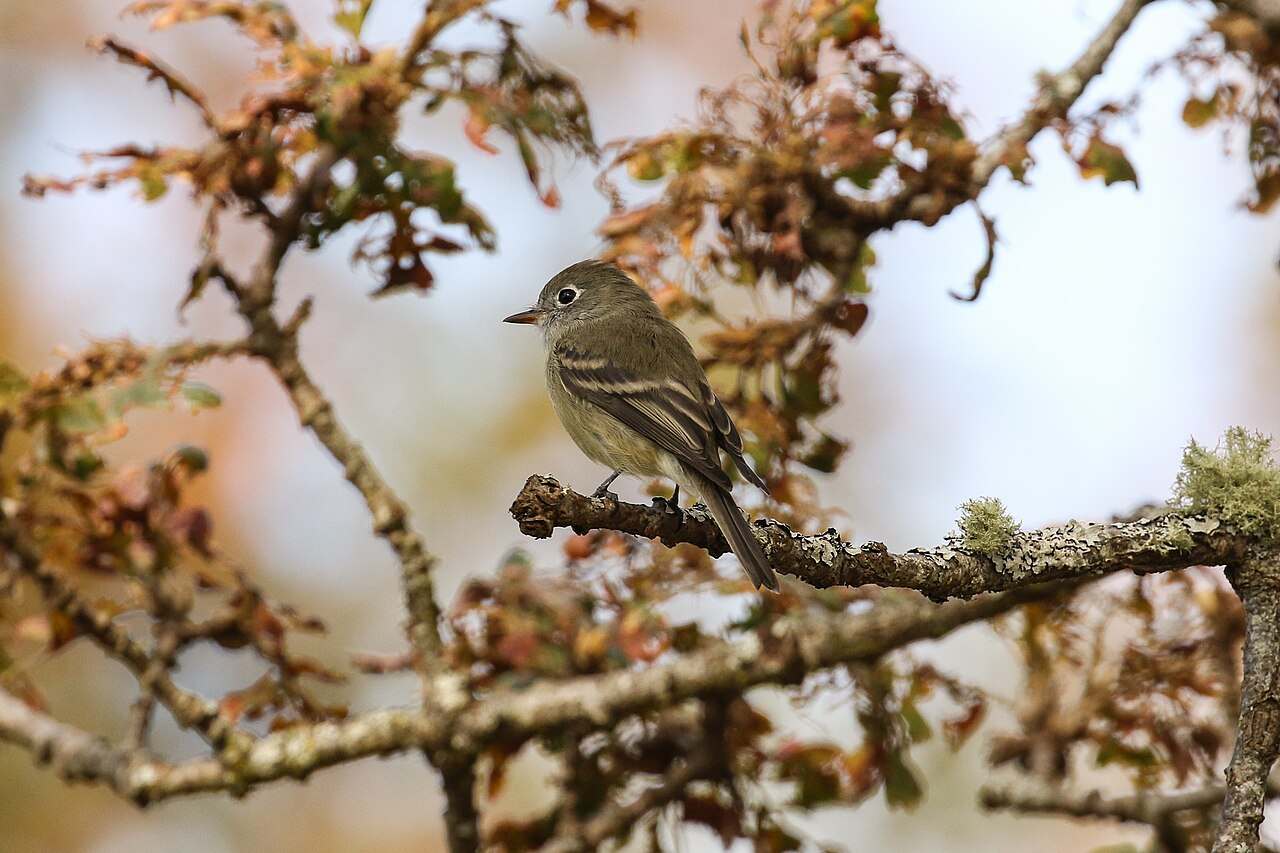
Hammond's flycatcher - Rocky Point, British Columbia
Temperament
solitary and territorial
Flight Pattern
short rapid sallies with brief hovering
Social Behavior
Pairs form on breeding territories where the female builds a neat cup nest on a horizontal conifer branch, often well out from the trunk. The species is monogamous in the breeding season and defends small territories. In winter it may join mixed-species flocks loosely in the midstory.
Migratory Pattern
Seasonal migrant
Song Description
Song is a series of high, thin, squeaky phrases, often rendered as a rising 'pst-SEE-bik' or short buzzes and tseets, carrying well in dense forests. Call notes are sharp, high 'seet' or 'pik' sounds. Voice is subtly different from other Empidonax flycatchers and is the best identification clue.
Plumage
Olive-gray above with slightly darker crown and back; underparts grayish with a pale whitish throat and a faint yellow or buff wash on the belly. Two crisp whitish wing bars and distinct pale edging on wing feathers. Feathers appear neat and smooth, with long primaries that project well past the tertials.
Diet
Feeds mainly on flying and foliage-dwelling insects such as flies, beetles, wasps, leafhoppers, and moths; also takes spiders. Typically sallies out from a shaded perch to snatch prey mid-air and returns to the same or nearby perch. Will glean from leaf surfaces and twigs, especially in cool, low-activity periods. Occasional consumption of small berries may occur in winter.
Preferred Environment
Forages within the shaded midstory to lower canopy of coniferous and mixed forests. During migration and winter it uses forest edges, riparian thickets, and pine–oak slopes where insects concentrate.


