

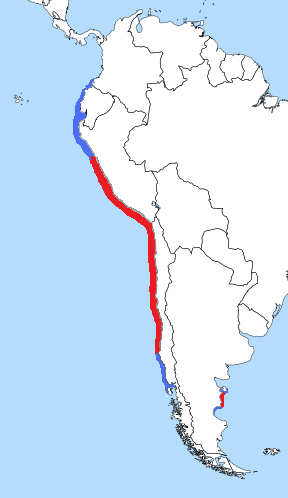
The guanay cormorant or guanay shag is a member of the cormorant family found on the Pacific coast of Peru and northern Chile. After breeding it spreads south to southern parts of Chile and north to Ecuador, and has also been recorded as far north as Panama and Colombia, probably a result of mass dispersal due to food shortage in El Niño years. Its major habitats include shallow seawater and rocky shores. A former population on the Patagonian Atlantic coast of Argentina appears to be extinct.
Region
Humboldt Current, Pacific coast of South America
Typical Environment
Breeds mainly along the Pacific coasts of Peru and northern Chile, concentrating on rocky offshore islands and headlands within the cold, nutrient-rich Humboldt Current. After breeding, birds disperse north to Ecuador and occasionally as far as Colombia and Panama, especially during El Niño years when prey shifts. Small numbers move south along the Chilean coast in some seasons. It favors guano islands and wave-washed cliffs with easy access to nearshore schools of fish. A former population on Argentina’s Patagonian Atlantic coast is considered extinct.
Altitude Range
Sea level to 200 m
Climate Zone
Arid
Ease of Keeping
Beginner friendly: 1/5
Once the principal producer of Peru’s famed guano, the Guanay cormorant historically formed immense colonies on offshore islands. Its numbers fluctuate with El Niño events and competition with fisheries for anchoveta. It is an agile pursuit diver that often forages in coordinated flocks with other seabirds. The species is a valuable indicator of the health of the Humboldt Current ecosystem.


Immatures in Pucusana, Peru
Temperament
highly social and colonial
Flight Pattern
direct, fast flight low over the water with rapid wingbeats
Social Behavior
Breeds in dense colonies on rocky islands, building nests of guano, seaweed, and debris on ledges or flat ground. Typically monogamous within a season; both sexes incubate and rear the young. Outside breeding, forms large rafts and often forages in coordinated lines or with mixed-species flocks.
Migratory Pattern
Partial migrant
Song Description
Generally silent at sea; colonies are noisy with low, guttural grunts and croaks. Adults also emit hissing and rasping calls during nest defense and pair interactions.
Plumage
Glossy black upperparts and head with clean white throat, breast, and belly; dark flanks create a sharp side demarcation. In breeding, fine white filamentous plumes appear on the head and neck.
Diet
Feeds mainly on small schooling fish, especially Peruvian anchoveta and sardines, supplemented by other pelagic fish and occasional crustaceans. It is a pursuit diver that propels itself underwater with its feet and partially with its wings. Foraging often occurs in large coordinated groups that herd fish toward the surface, sometimes alongside boobies, pelicans, and terns.
Preferred Environment
Nearshore upwelling zones, tide rips, and around rocky islands where baitfish concentrate. Typically works the surface-to-midwater column over the continental shelf and along current edges.


