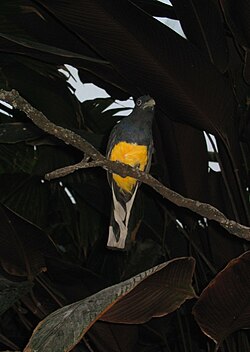
The green-backed trogon, also known as the Amazonian white-tailed trogon, is a bird in the trogon family Trogonidae. It is widely distributed across the Amazon rainforest with a disjunct population on the southeast coast of Brazil. As with all trogons, this species is sexually dimorphic. The male has a yellow belly without a white breastband, a blue head with a pale-blue orbital eye-ring, a blue bill, a green back and a green tail that is mostly white below. The female is duller with a dark grey head, a dark grey back and some black barring beneath the tail.
Region
Amazon Basin and Atlantic Forest (southeast Brazil)
Typical Environment
Widely distributed across lowland Amazonian rainforest, including both terra firme and várzea, and found in a disjunct population in the Atlantic Forest along Brazil’s southeast coast. It uses mature forest, edges, riverine gallery forest, and tall secondary growth. Most activity occurs in the midstory to canopy where it forages from shaded perches. It is generally absent from open country but may appear along forested riparian corridors.
Altitude Range
Sea level to 1200 m
Climate Zone
Tropical
Ease of Keeping
Beginner friendly: 1/5
Also called the Amazonian white-tailed trogon, this species was formerly lumped with the white-tailed trogon complex before taxonomic splits clarified its range and features. Males show a striking pale-blue orbital ring and a mostly white undertail, while females are greyer and more subdued. It often nests in arboreal termite nests or rotting stumps, excavating its own cavity. Typically sedentary, it is a classic perch-and-sally forager of tropical forests.


Female with abnormally dark bill
Temperament
usually quiet, calm, and fairly sedentary
Flight Pattern
short rapid wingbeats between perches; brief, direct flights with occasional short glides
Social Behavior
Most often seen singly or in pairs, sometimes loosely associating with mixed-species flocks. Pairs maintain small territories and perform soft duets. Nesting usually occurs in cavities excavated in arboreal termite nests or decayed wood; both sexes participate in excavation and incubation. Clutches are small, and both parents feed the young.
Migratory Pattern
Resident
Song Description
A series of low, resonant hoots given in steady tempo, often carrying far through the forest. Calls include soft coos and clucks used in pair contact.
Plumage
Male with glossy green back, blue-toned head, bright yellow underparts lacking a white breastband, and an undertail that is largely white with dark edging; female duller with dark grey head and back and more barring below the tail.
Diet
Takes a mixed diet of arthropods such as beetles, katydids, and grasshoppers, along with various fruits including figs and other soft berries. It hunts by sallying from a shaded perch to snatch prey in the air or glean from foliage. Fruit is often swallowed whole and may be a significant component in some seasons. Occasionally captures small vertebrates but this is uncommon.
Preferred Environment
Forages in the forest midstory and lower canopy, especially along edges, river margins, and light gaps. Often selects quiet perches with good vantage points for short sallies.