

The great crested flycatcher is a large insect-eating bird of the tyrant flycatcher family. It is the most widespread member of the genus Myiarchus in North America, and is found over most of the eastern and mid-western portions of the continent. It dwells mostly in the treetops and rarely is found on the ground.
Region
Eastern North America to northern South America
Typical Environment
Breeds across the eastern and central United States and southern Canada, favoring mature deciduous and mixed forests, woodlots, and forest edges. During the nonbreeding season it migrates to Mexico, Central America, the Caribbean, and northern South America. It is most often encountered high in the canopy and is scarce on the ground. Urban parks with large trees and riparian corridors can also host this species.
Altitude Range
Sea level to 2000 m
Climate Zone
Other
Ease of Keeping
Beginner friendly: 1/5
This treetop hunter rarely descends to the ground, sallying from high perches to catch insects in midair. It often nests in tree cavities and is famous for lining its nest with shed snakeskin (or modern substitutes like cellophane). Its loud, ringing whee-eep call carries far through woodland canopies.


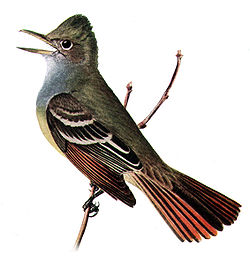
Great crested flycatcher in Florida Keys

Adult in Eastern Maryland with its catch for the nestlings



Temperament
solitary and territorial
Flight Pattern
short rapid wingbeats with agile sallying flights
Social Behavior
Typically forms monogamous pairs during the breeding season and defends nesting territories. Nests in natural cavities or old woodpecker holes, often adding snakeskin to the lining. Outside the breeding season it may loosely associate with mixed-species flocks in the canopy.
Migratory Pattern
Seasonal migrant
Song Description
A loud, ringing whee-eep or kree-eep whistle, often given from high perches. Also produces a series of sharp, repeated phrases and rattling calls in dawn choruses.
Plumage
Olive-brown upperparts with a gray throat and breast, bright sulfur-yellow belly, and warm rufous tones in the tail and wing feathers.
Diet
Primarily consumes flying insects such as beetles, wasps, flies, and moths, captured by sallying from exposed perches. It also gleans insects from foliage and occasionally hawks prey in short chases. In late summer and winter it adds fruits and berries, including wild cherries, mulberries, and dogwoods.
Preferred Environment
Forages high in the mid to upper canopy of mature forests, wood edges, and groves with large trees. Will also feed along riparian corridors and in spacious parks where tall trees offer vantage perches.


