Goldie's bird-of-paradise is a species of bird-of-paradise.
Region
D'Entrecasteaux Islands, Papua New Guinea
Typical Environment
Occurs in primary and mature secondary rainforest on Fergusson and Normanby, favoring hill and lower montane slopes. It uses mid to upper canopy strata, especially around fruiting trees on ridges and along forest edges. The species tolerates some selective logging but declines where forest is heavily fragmented. Breeding and display arenas are typically in intact forest with large trees.
Altitude Range
200–1200 m
Climate Zone
Tropical
Ease of Keeping
Beginner friendly: 1/5
Goldie's bird-of-paradise is restricted to two islands in Papua New Guinea, making it especially vulnerable to habitat loss. Males gather at display sites (leks) where they perform elaborate dances, showing off vivid flank plumes and long tail wires to attract females. The species is threatened by forest clearing and past hunting for plumes, and conservation efforts focus on protecting remaining hill forest.

Temperament
secretive and wary
Flight Pattern
short rapid wingbeats between canopy perches
Social Behavior
Polygynous lekking species: males display at traditional courts where several may gather to perform. Females visit leks to select mates and then alone build a cup nest and rear the young. Pairs do not form lasting bonds.
Migratory Pattern
Resident
Song Description
Vocalizations include loud, ringing calls and rasping notes delivered from high perches near display courts. Males also produce mechanical sounds with wings and plumes during display sequences.
Plumage
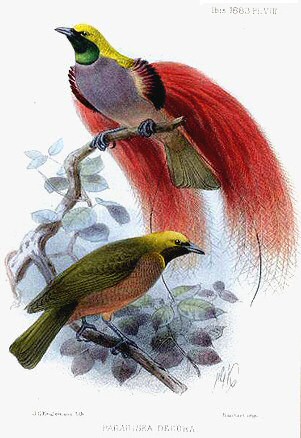
Male with rich chestnut-brown body, yellowish crown, iridescent green throat, and luxuriant orange‑red flank plumes with two long, wire-like tail filaments; female is warm brown above with paler, finely barred underparts.
Diet
Primarily frugivorous, taking a wide variety of soft fruits, particularly figs and laurels. Supplements diet with arthropods gleaned from foliage and bark, especially during nesting. Occasionally consumes small invertebrates flushed during foraging at fruiting trees.
Preferred Environment
Feeds in the mid to upper canopy of intact and lightly disturbed hill forest. Often concentrates at fruiting trees along ridges, forest gaps, and edges. Will descend to lower strata when fruit is abundant.