

The Goliath heron, also known as the giant heron, is a very large wading bird of the heron family, Ardeidae. It is found in sub-Saharan Africa, with smaller, declining numbers in Southwest and South Asia.
Region
Sub-Saharan Africa and parts of South and Southwest Asia
Typical Environment
Most numerous across sub-Saharan Africa in large lakes, broad rivers, swamps, floodplains, estuaries, and mangroves. Small, declining outposts occur in parts of South and Southwest Asia. It favors expansive, shallow waters with good visibility and secluded, lightly disturbed shorelines. Nests are usually close to water, sometimes on isolated trees or reedbeds, which offer protection from predators and people.
Altitude Range
Sea level to 2000 m
Climate Zone
Tropical
Ease of Keeping
Beginner friendly: 1/5
The Goliath heron is the world’s largest heron, towering over other waders with an immense bill built for spearing large fish. It usually hunts alone, standing motionless or stalking with deliberate steps in shallow water. Nests are bulky stick platforms placed in trees, reeds, or on islands near water. The species is sensitive to disturbance and relies on relatively undisturbed shorelines.


Ardea goliath egg

At iSimangaliso Wetland Park, KwaZulu Natal, South Africa
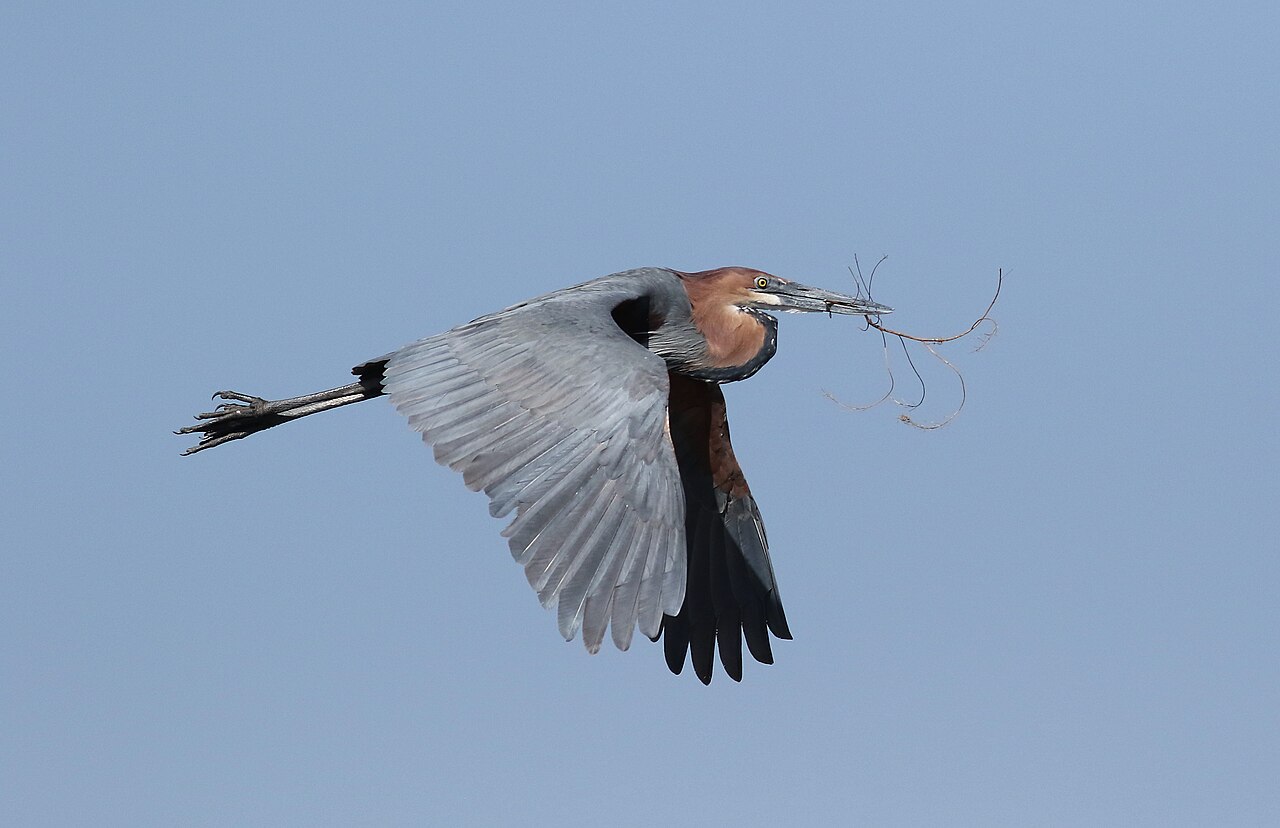
Adult transporting nesting material

Fledglings in the Kruger National Park
Temperament
solitary and territorial
Flight Pattern
slow, deep wingbeats; steady flier
Social Behavior
Typically hunts alone and defends rich feeding territories. Breeds singly or in loose colonies; pairs are monogamous during the season and both sexes build the nest and care for young. Nests are placed near water in trees, on islands, or within reedbeds.
Migratory Pattern
Resident
Song Description
Generally quiet away from nests, but gives deep, booming grunts and croaks, especially in flight or when alarmed. At colonies it produces resonant barks and growls, carrying over water.
Plumage
Massive heron with slate-gray upperparts, rich chestnut head and neck, and shaggy breast plumes; the foreneck shows bold black streaking with a contrasting pale throat line.
Diet
Primarily fishes, often sizable species that it spears and swallows head-first. Also takes amphibians, crustaceans, aquatic insects, small reptiles, and occasionally small mammals. Hunts by standing motionless or by very slow stalking, striking with a rapid thrust of the bill.
Preferred Environment
Shallow margins of large lakes, slow-moving rivers, deltas, flooded plains, estuaries, and mangroves. Prefers quiet, undisturbed sites with open water and sparse emergent vegetation.


