

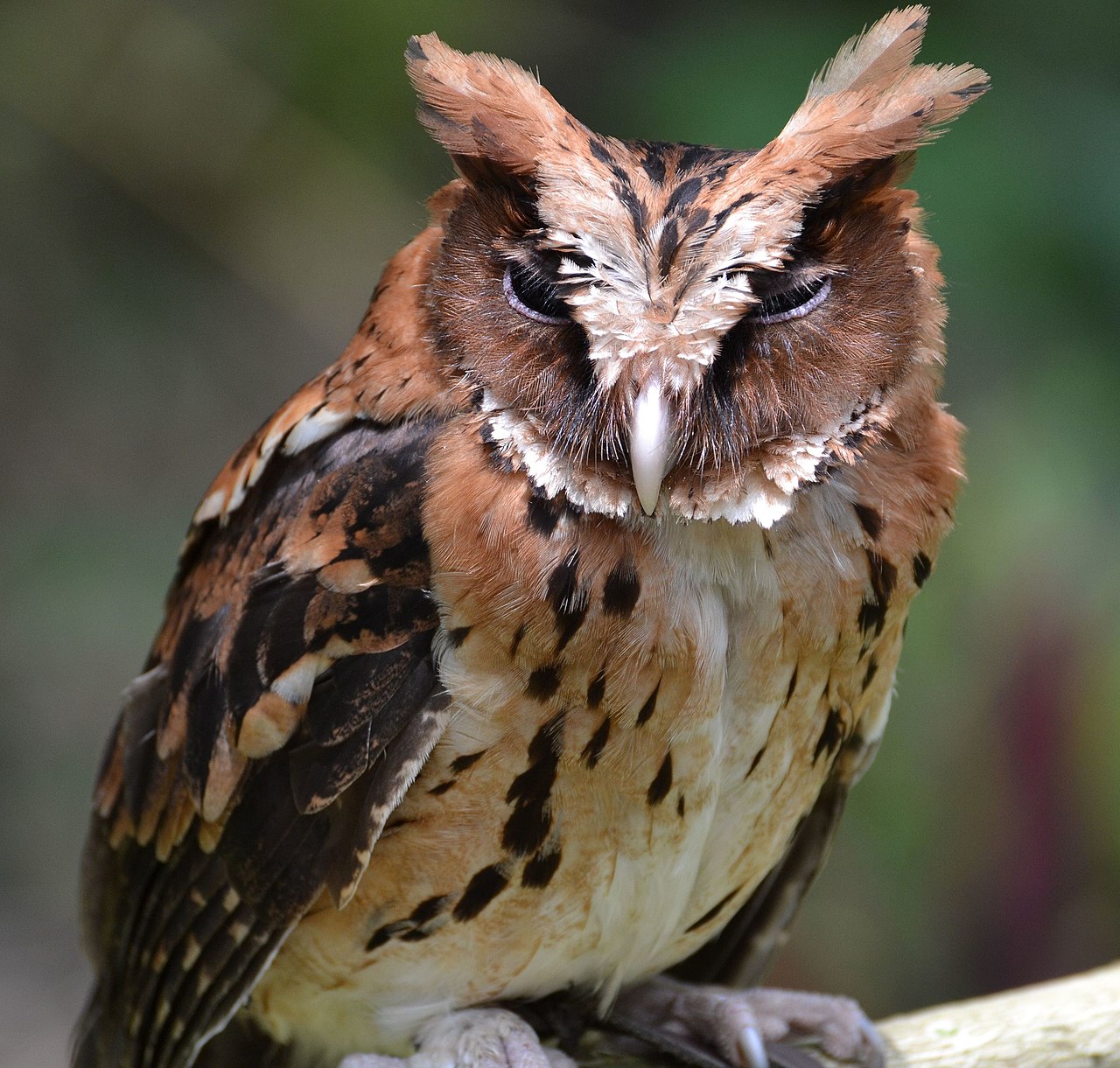
The giant scops owl, lesser eagle owl, Mindanao eagle owl or Mindanao owl, is a species of owl in the family Strigidae. It is endemic to the Philippines found on the islands of Mindanao, Dinagat Islands, Siargao and was only discovered in Samar in 2010. In size and structure, it is considered intermediate between a scops owl and an eagle-owl. Its natural habitat is tropical moist lowland forests. It is threatened by habitat loss.
Region
Southeast Asia
Typical Environment
Endemic to the Philippines, occurring on Mindanao, Dinagat, Siargao, and confirmed on Samar. It inhabits tropical moist lowland and foothill forests, including primary rainforest and older secondary growth with tall canopy. The owl favors dense interior forest, riparian forest, and edges adjoining clearings where prey activity is high. It generally avoids heavily logged or fragmented habitats and is sensitive to extensive canopy loss.
Altitude Range
Sea level to 1200 m
Climate Zone
Tropical
Ease of Keeping
Beginner friendly: 1/5
Also known as the Mindanao eagle-owl or lesser eagle-owl, it was long placed in the monotypic genus Mimizuku before being moved to Otus. It is a secretive, forest-dependent owl whose booming, low hoots are often the only clue to its presence. The species was only recently confirmed on Samar in 2010, expanding its known range in the Philippines. Ongoing deforestation is the principal threat to its survival.


''Otus gurneyi'' on a 2004 stamp and postcard of the Philippines
Temperament
solitary and territorial
Flight Pattern
short, silent wingbeats with brief glides
Social Behavior
Largely solitary outside the breeding season, roosting quietly in dense foliage by day. Pairs are presumed monogamous and nest in tree cavities or natural hollows. They defend territories with persistent vocal displays at night and may hunt from repeated perch sites.
Migratory Pattern
Resident
Song Description
Deep, resonant hoots given in spaced series, often carrying far through forest at night. Also emits gruff barks and soft growls when agitated or at close range.
Plumage
Heavily mottled and streaked rufous-brown to dark brown with fine barring; dense feathering gives a shaggy look. Prominent ear tufts and a rounded facial disk with a dark rim. Underparts are buff to rufous with bold dark streaks and fine crossbarring.
Diet
Primarily takes large insects such as beetles, katydids, and cicadas, supplemented by small vertebrates including rodents, small birds, lizards, and frogs. Hunts from a perch, dropping to the ground or making short sallies to capture prey. Uses keen hearing and silent flight to locate prey in dense understory.
Preferred Environment
Forages within interior lowland forest, along forest edges, and above streams where insect activity is concentrated. Often hunts from mid-level perches overlooking clearings or gaps.


