

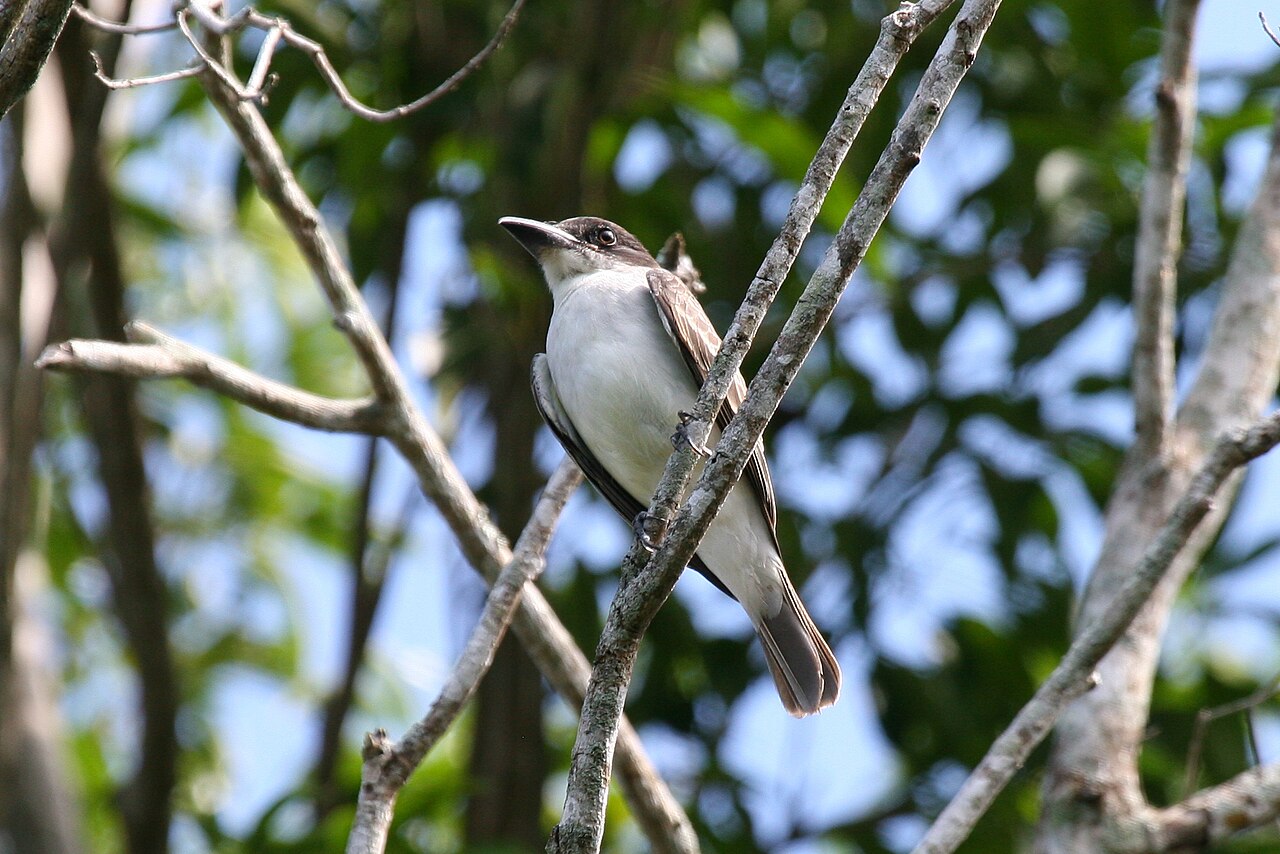
The giant kingbird is an Endangered species of bird in the tyrant flycatcher family Tyrannidae. It is endemic to Cuba.
Region
Greater Antilles (Cuba)
Typical Environment
Occurs across parts of Cuba and adjacent cays, including pine savannas, gallery forests, mangrove edges, and semi-open woodlands with tall trees. It favors ecotones and forest edges where high perches are available for aerial sallies. It can be found in mature pine forests, palm-dotted savannas, and tall secondary growth near watercourses. Historically scarce and patchy, it persists where extensive tracts of tall woodland remain.
Altitude Range
Sea level to 800 m
Climate Zone
Tropical
Ease of Keeping
Beginner friendly: 1/5
The giant kingbird is the largest member of the kingbird genus Tyrannus, sporting a notably heavy bill for taking larger prey. It is confined to Cuba and nearby islets and has declined due to habitat loss and degradation. It often hunts from tall exposed perches, sallying out to catch flying insects and occasionally taking fruit.



Temperament
solitary and territorial
Flight Pattern
short rapid wingbeats with strong sallies from high perches
Social Behavior
Typically seen alone or in pairs, especially during the breeding season. Pairs defend territories and nest high in tall trees, often near clearings or edges. Both parents participate in territorial defense and provisioning.
Migratory Pattern
Resident
Song Description
Vocalizations include sharp kip and kreet notes, harsh chatters, and rattling series delivered from exposed perches. Dawn song is a short sequence of squeaky whistles and nasal phrases, often interspersed with scolds.
Plumage
Dark gray-brown upperparts with paler gray underparts and whitish throat; wings show faint pale edging. Head appears dusky with a subtle mask and a large, heavy bill. Tail is long and slightly notched without a bold white terminal band.
Diet
Primarily large flying insects such as beetles, wasps, dragonflies, and grasshoppers, caught on the wing. It also gleans from foliage and occasionally drops to the ground after prey. Seasonal fruit and berries are taken, especially when insect activity is lower.
Preferred Environment
Hunts from tall snags, exposed branches, and utility lines along forest edges, savannas, and mangrove margins. Often forages near clearings or over open spaces adjacent to woodland.


