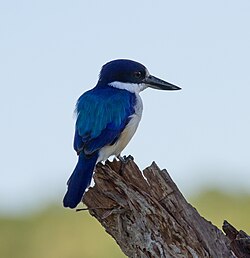
The forest kingfisher, also known as Macleay's or the blue kingfisher, is a species of kingfisher in the subfamily Halcyoninae, also known as tree kingfishers. It is a predominantly a blue and white bird. It is found in Indonesia, New Guinea and coastal eastern and Northern Australia. Like many other kingfishers, it hunts invertebrates, small frogs, and lizards.
Region
Australasia
Typical Environment
Occurs across coastal and near-coastal northern and eastern Australia, southern New Guinea, and parts of eastern Indonesia. It frequents open eucalypt woodland, forest edges, paperbark swamps, and mangroves, as well as clearings and parks. The species is typically associated with watercourses, estuaries, and wet-dry monsoon woodlands but also uses drier edges for foraging. Breeding is most common in northern and eastern Australia, with seasonal movements influencing local presence.
Altitude Range
Sea level to 1000 m
Climate Zone
Tropical
Ease of Keeping
Beginner friendly: 1/5
Forest kingfishers are brilliant blue-and-white tree kingfishers that hunt by perching quietly and striking down onto prey. In northern Australia they often excavate nest chambers in arboreal termite mounds, which provide excellent insulation and protection. They are partial migrants in parts of Australia, moving south to breed in the warmer months and retreating northward after. Despite the name, they are not strictly tied to dense forest and commonly use open woodland and mangroves.


Temperament
alert and territorial
Flight Pattern
short rapid wingbeats with direct, low flights between perches
Social Behavior
Typically seen singly or in pairs holding well-defined territories, especially in the breeding season. Nests are often excavated in active arboreal termite mounds or occasionally in tree cavities. Both sexes contribute to excavating and feeding the young.
Migratory Pattern
Partial migrant
Song Description
A sharp, metallic series of keks and chatter, often delivered from an exposed perch. Territorial calls are rapid, ringing rattles that carry well through woodland. Softer contact notes are used between pair members.
Plumage
Glossy cobalt-blue upperparts with a clean white throat, breast, and belly; contrasting black eye-stripe and white collar. Wings are dark with blue gloss; tail blue. Juveniles are duller with buffy wash and less vivid blue.
Diet
Primarily takes large insects such as beetles, grasshoppers, and mantises, along with spiders. It also consumes small reptiles and amphibians when available, and occasionally small crustaceans. Prey is typically subdued by beating against a perch before swallowing.
Preferred Environment
Hunts from open perches along forest edges, woodland clearings, mangroves, and near water. Frequently uses fence posts, low branches, or exposed snags to scan for ground or low-vegetation prey.