
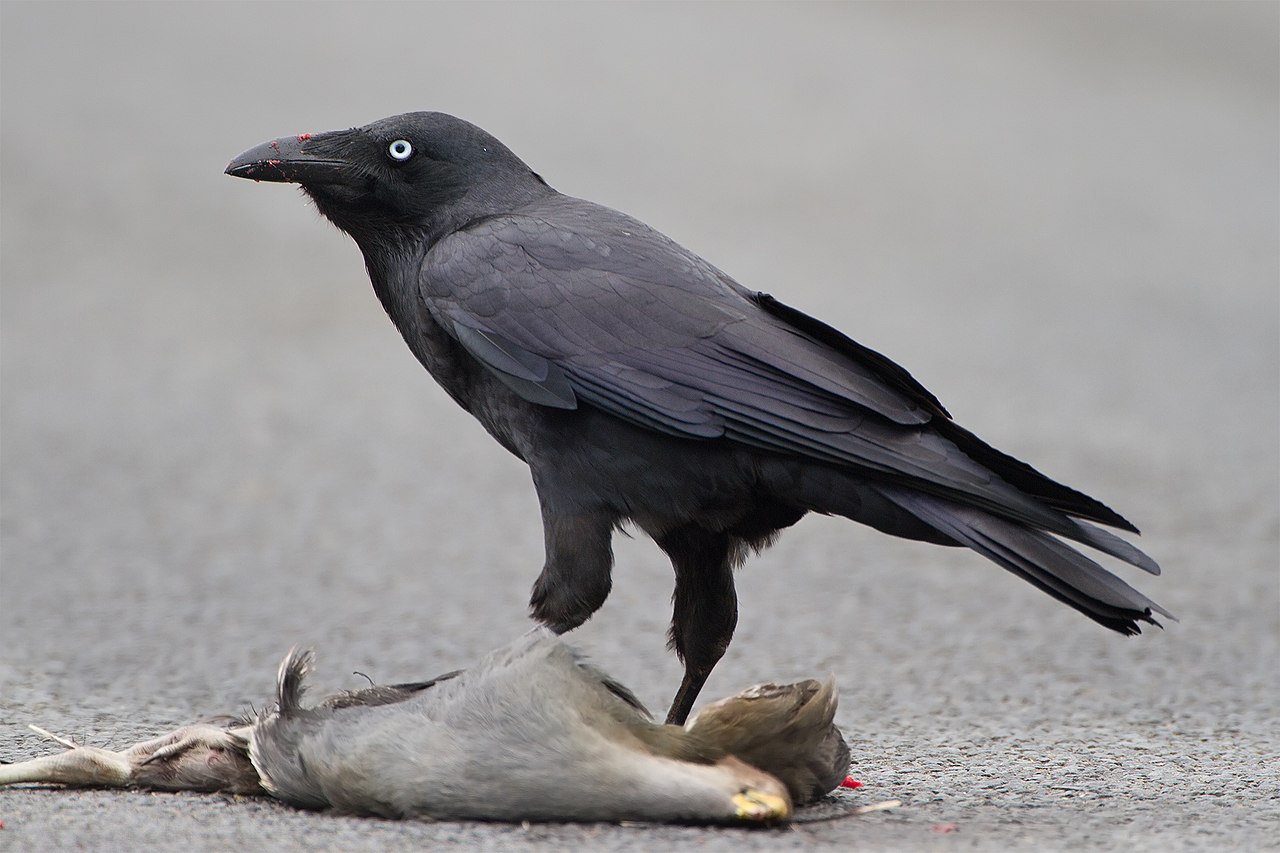
The forest raven, also commonly known as the Tasmanian raven, is a passerine bird in the family Corvidae native to Tasmania and parts of southern Victoria, such as Wilsons Promontory and Portland. Populations are also found in parts of New South Wales, including Dorrigo and Armidale. Measuring 50–53 cm (20–21 in) in length, it has all-black plumage, beak and legs. As with the other two species of raven in Australia, its black feathers have grey bases. Adults have white irises; younger birds have dark brown and then hazel irises with an inner blue rim. New South Wales populations are recognised as a separate subspecies C. tasmanicus boreus, but appear to be nested within the Tasmanian subspecies genetically.
Region
Tasmania and southeastern Australia
Typical Environment
Common and widespread throughout Tasmania, with populations in southern Victoria (e.g., Wilsons Promontory and Portland) and parts of New South Wales (e.g., Dorrigo and Armidale). Occupies wet and dry eucalypt forests, temperate rainforest margins, coastal heath, open farmland, and urban fringes. Frequently forages along roadsides and beaches where carrion and intertidal resources are available. Nests high in tall eucalypts or other large trees, often near forest edges.
Altitude Range
Sea level to 1500 m
Climate Zone
Temperate
Ease of Keeping
Beginner friendly: 1/5
The forest raven, often called the Tasmanian raven, is the only raven species resident across Tasmania and extends into parts of southeastern mainland Australia. Adults have striking white irises, while juveniles transition from dark brown to hazel with a bluish inner rim. A mainland New South Wales population is sometimes treated as subspecies C. t. boreus. Highly intelligent and adaptable, it readily exploits natural food sources and human-altered habitats.


Plumage showing glossy sheen in sunlight – Mole Creek, Tasmania

a forest raven perched in a wood pasture within Rocky Cape National Park, Tasmania, Australia
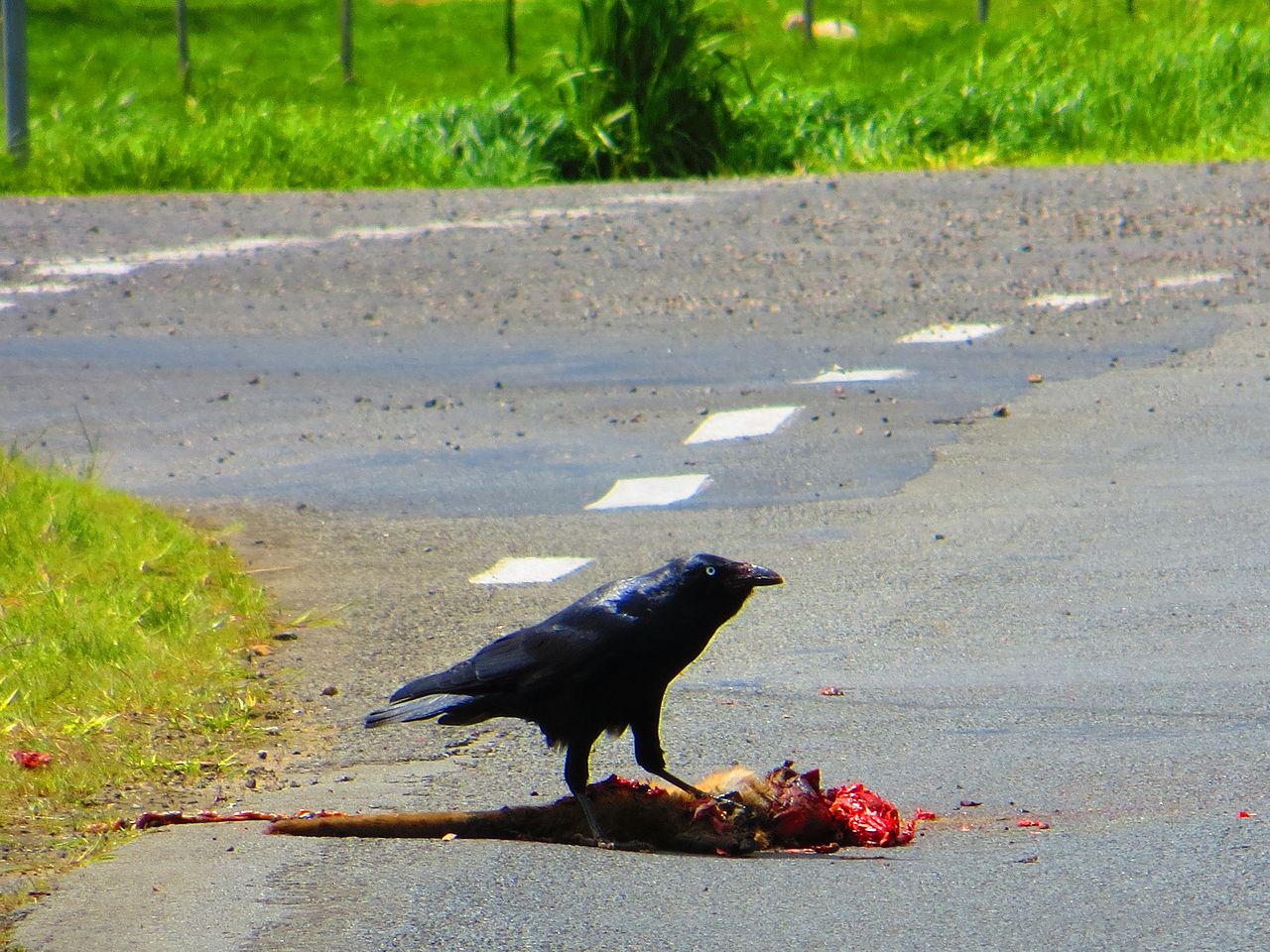
Forest raven feeding on the remains of a roadkilled kangaroo, Mole Creek, Tasmania, Australia
Temperament
bold and intelligent
Flight Pattern
strong flier with steady wingbeats and occasional glides
Social Behavior
Typically seen in pairs or small family groups, becoming more gregarious around rich food sources. Forms long-term pair bonds and defends territories, especially during breeding. Builds large stick nests high in tall trees; both parents attend the young.
Migratory Pattern
Resident
Song Description
Deep, resonant croaks and drawn-out, guttural calls, often delivered from a perch. Calls are lower and less wailing than some other Australian ravens, with repeated ‘korr’ notes.
Plumage
All-black, glossy plumage with grey feather bases and shaggy throat hackles.
Diet
Omnivorous, taking insects and other invertebrates, small vertebrates, carrion, grains and seeds, fruits, and human refuse. Frequently scavenges roadkill and visits coastal areas for stranded marine items. Will raid nests for eggs and nestlings when opportunity arises.
Preferred Environment
Forages on the ground in pastures, forest edges, and clearings, and along shorelines and estuaries. Also exploits urban parks, tips, and agricultural fields.


