
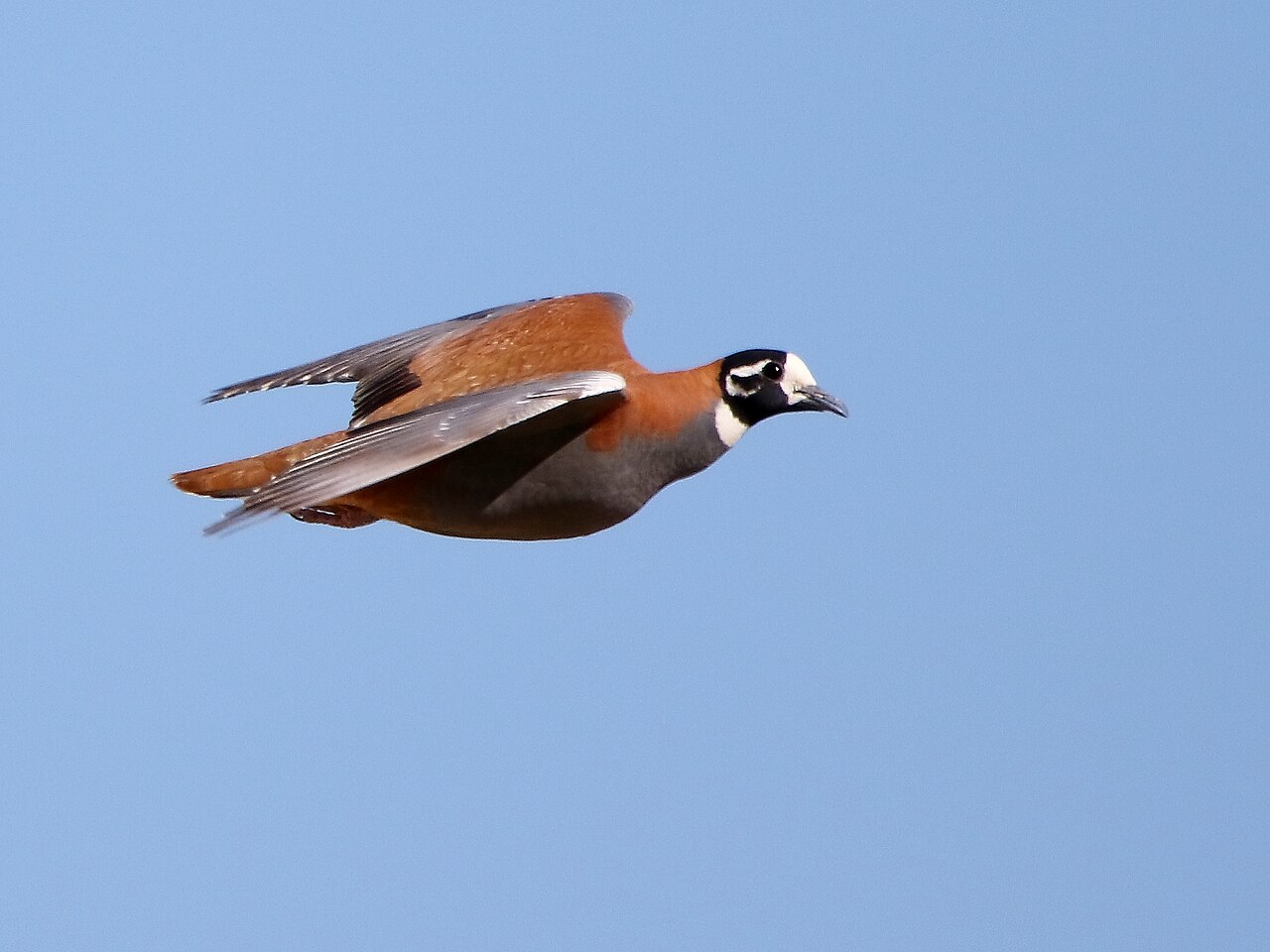
The flock bronzewing, also known as the flock pigeon, harlequin bronzewing and the harlequin pigeon is a species of pigeon in the family Columbidae. It is endemic to drier parts of Australia.
Region
Australian arid and semi-arid interior
Typical Environment
Occurs across the inland of Australia where rainfall is erratic, especially in open tussock grasslands, chenopod shrublands, and stony gibber plains. It also uses the edges of spinifex and sparse acacia shrublands. Flocks shift range widely after rains to exploit seeding grasses and forbs. Roosting may occur in low trees or on the ground near open country. It frequents waterholes and stock dams, especially in dry periods.
Altitude Range
0–800 m
Climate Zone
Arid
Ease of Keeping
Beginner friendly: 1/5
Also called the harlequin bronzewing, this pigeon forms impressive flocks that roam Australia’s arid interior after rainfall. Males show a striking black-and-white facial mask and an iridescent bronze-green wing panel. Movements are highly nomadic, tracking seed flushes across grasslands and gibber plains. Habitat change from overgrazing, altered fire regimes, and introduced predators can locally impact numbers.


Syntype of Peristera histrionica Gould (NML-VZ D1486b) held at World Museum, National Museums Liverpool
Temperament
social and wary
Flight Pattern
fast, low direct flight with rapid wingbeats
Social Behavior
Often gathers in large, cohesive flocks that feed and travel together. Breeding is opportunistic after rainfall, with pairs nesting on or near the ground under low shrubs or grass tussocks. Pairs are monogamous during the breeding cycle, and colonies may form where food is abundant.
Migratory Pattern
Nomadic, following rainfall and seed availability
Song Description
A series of soft, low coos given from the ground or low perch; generally quiet and unobtrusive. On flushing, wings may clap audibly, and flight calls are brief and subdued.
Plumage
Ground-dove with grey-brown upperparts, pale underparts, and a glossy bronzed wing panel. Males have a bold black-and-white facial mask and a chestnut shoulder patch; females are duller with less contrast. Feathers are compact and smooth, suited to fast, direct flight.
Diet
Primarily eats seeds of native grasses (e.g., Mitchell grass), herbs, and forbs. Will take green shoots and leaves when available, especially after rain. Rarely consumes small invertebrates incidentally while foraging on the ground. Requires regular access to water and may travel to known water sources daily in dry conditions.
Preferred Environment
Feeds on open, sparsely vegetated ground including gibber plains, short-grass flats, and around waterholes and stock dams. Often forages along track edges and in recently burnt or rain-flushed areas where seeds are abundant.


