

The European herring gull or simply herring gull is a large gull, up to 66 cm (26 in) long. It breeds throughout the northern and western coasts of Europe. Some European herring gulls, especially those resident in colder areas, migrate farther south in winter, but many are permanent residents, such as in Ireland, Britain, Iceland, or on the North Sea shores. They have a varied diet, including fish, crustaceans, as well as some plants, and are also scavengers, consuming carrion and food left by or stolen from humans.
Region
Northern and Western Europe and the North Atlantic coasts
Typical Environment
Breeds along rocky and sandy coasts, islands, estuaries, and increasingly on buildings in coastal towns. Also occurs far inland around large lakes, reservoirs, farmland, and landfill sites. Winters along coasts and estuaries, with many birds moving south to the Bay of Biscay, the Mediterranean, and northwest Africa. Frequently follows fishing vessels and exploits urban food sources.
Altitude Range
Sea level to 1500 m
Climate Zone
Temperate
Ease of Keeping
Beginner friendly: 1/5
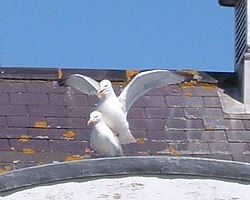
Highly adaptable, European herring gulls now breed widely in towns and cities, often nesting on rooftops. Chicks instinctively peck at the red spot on the adult’s bill to trigger regurgitation feeding. They frequently practice kleptoparasitism, stealing food from other birds or humans. Individuals can live for several decades, with banded birds recorded over 30 years old.


Two L. a. argenteus individuals on the shore of Coumeenoole Bay, Ireland


Adult L. argentatus with yellow legs to the right, its offspring has the normal pink colour. This bird is not to be confused with the always yellow-legged Larus michahellis. Photo from Warnemünde (harbour of Rostock), Mecklenburg-Vorpommern, northern Germany.

An adult pair, the one on the right is of the Omissus variety.

European herring gulls foraging in a pile of burnt grain at Lantmännens in Ystad 2021.

Fighting for a fish.

Adult in winter plumage with begging 1cy juvenile.

Eggs, Collection Museum Wiesbaden, Germany


Tearing open a bin bag

Stealing food from a man's hand

Perching on spikes designed to discourage perching birds

Rubbish bag designed to resist scavenging behaviour
Temperament
opportunistic and assertive
Flight Pattern
strong flier with steady wingbeats and broad soaring glides
Social Behavior
Forms dense colonies on cliffs, islands, and rooftops during breeding season. Generally monogamous with long-term pair bonds; both sexes incubate and feed chicks. Outside breeding, gathers in large flocks at feeding sites such as estuaries, fields, and landfills.
Migratory Pattern
Partial migrant
Song Description
Loud, laughing ‘kee-ow’ and ‘ha-ha-ha’ calls, including the classic long call given with head thrown back. Also produces mewing, yelps, and harsh scolds, with a wide repertoire used in social and territorial displays.
Plumage
Adult with pale grey mantle, white head and underparts, and black wingtips with white mirrors; in winter the head often shows fine grey-brown streaking. Juveniles and immatures are mottled brown, gradually becoming paler and greyer over several years.
Diet
Takes fish, marine invertebrates, carrion, and refuse, and will hunt small birds, eggs, and chicks when opportunities arise. Forages by dipping, surface-seizing, and pattering along the shore, and often follows fishing boats. Frequently scavenges at landfills and harbors and will take earthworms and invertebrates from fields. Also consumes some plant material such as seeds and berries.
Preferred Environment
Shorelines, estuaries, harbors, piers, and beaches are primary foraging areas. Inland, it uses lakes, reservoirs, farmland, urban streets, and refuse sites. Often exploits human-altered habitats where food is abundant.


