

The European red-rumped swallow is a small passerine bird in the swallow family Hirundinidae. It breeds in open hilly country of southern Europe and north Africa east to Iran, Pakistan and northwest India. During winter it migrates to Africa and southwest Asia. It was formerly considered to be a subspecies of the eastern red-rumped swallow, united under the common name of “red-rumped swallow”.
Region
Southern Europe, North Africa, and West to South Asia
Typical Environment
Breeds in open hilly and lightly wooded country from the Mediterranean basin across North Africa and the Middle East to Iran, Pakistan, and northwest India. Prefers cliffs, gorges, and escarpments but readily uses human structures for nesting. Frequently forages over farmland, scrubby slopes, and near rivers or reservoirs. Winters mainly in sub-Saharan Africa and southwest Asia, concentrating where flying insects are abundant.
Altitude Range
Sea level to 2500 m
Climate Zone
Temperate
Ease of Keeping
Beginner friendly: 1/5
European red-rumped swallows build neat, flask-shaped mud nests with long entrance tunnels on cliffs, caves, and increasingly under bridges and eaves. They are agile aerial insect hunters and often forage over open hillsides and near water. Expansion of suitable man-made structures has helped the species extend its range northward in parts of Europe.
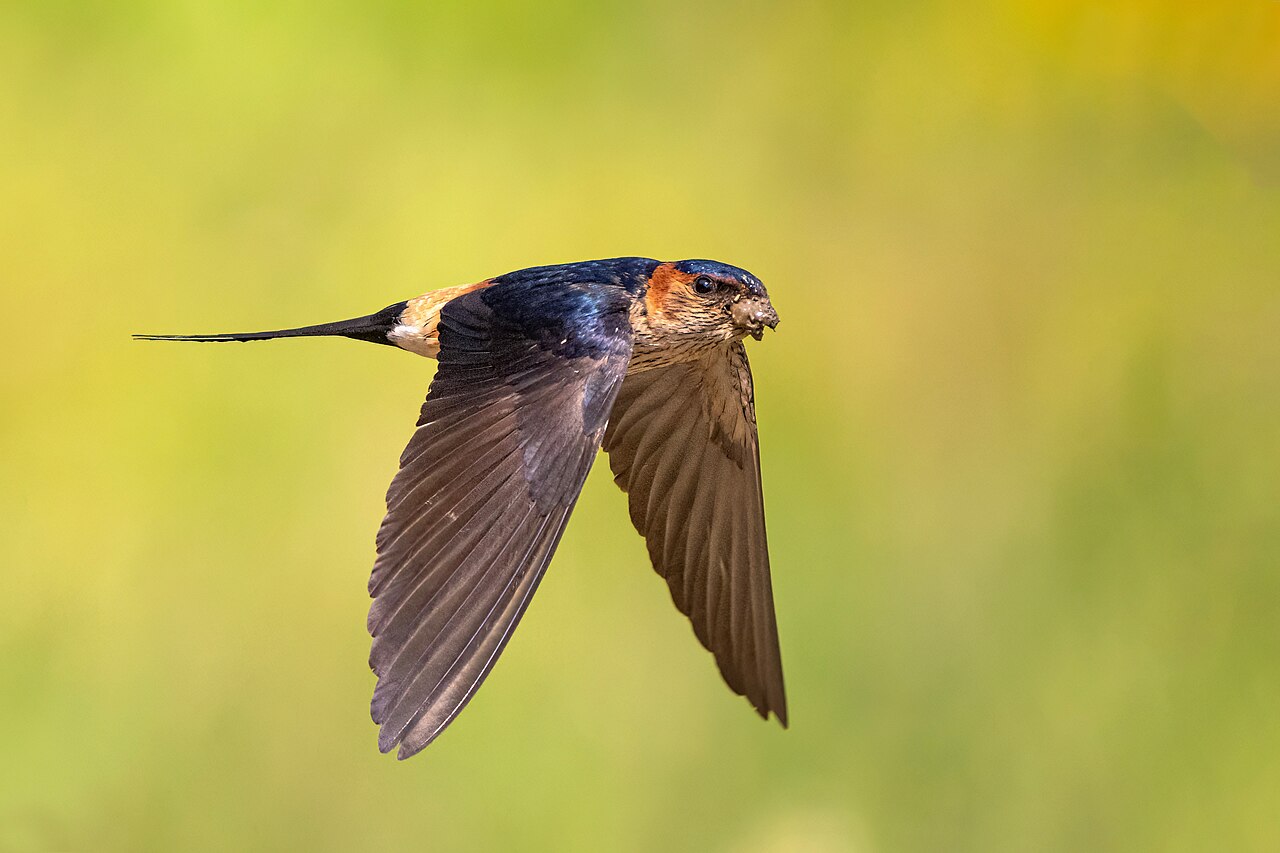
In flight with nesting material
Temperament
social and active
Flight Pattern
agile flier with swift, elastic wingbeats and frequent glides
Social Behavior
Usually nests in loose colonies or small groups, with both sexes building the enclosed mud nest and tunnel. Pairs are typically monogamous for a season, and two broods may be raised where conditions allow. Roosts communally outside the breeding season.
Migratory Pattern
Seasonal migrant
Song Description
A soft, twittering warble interspersed with dry buzzes and chirps. Calls are quieter and less ringing than those of barn swallows, often given in flight around colonies.
Plumage
Glossy blue-black upperparts with a rich rufous nape and rump; pale buff underparts with fine, dark streaking. Long, pointed wings and a shallowly forked tail with subtle white spots on the tail feathers.
Diet
Feeds almost exclusively on flying insects such as flies, beetles, ants, and small wasps, taken on the wing. Hunts at low to moderate heights, often following contour lines along slopes and cliff faces. Will exploit swarms of emergent aquatic insects and occasionally drinks while flying.
Preferred Environment
Forages over open countryside, farmland, and near water bodies, including reservoirs and rivers. Frequently hunts around cliffs, quarries, and man-made structures that also provide nesting sites.


