
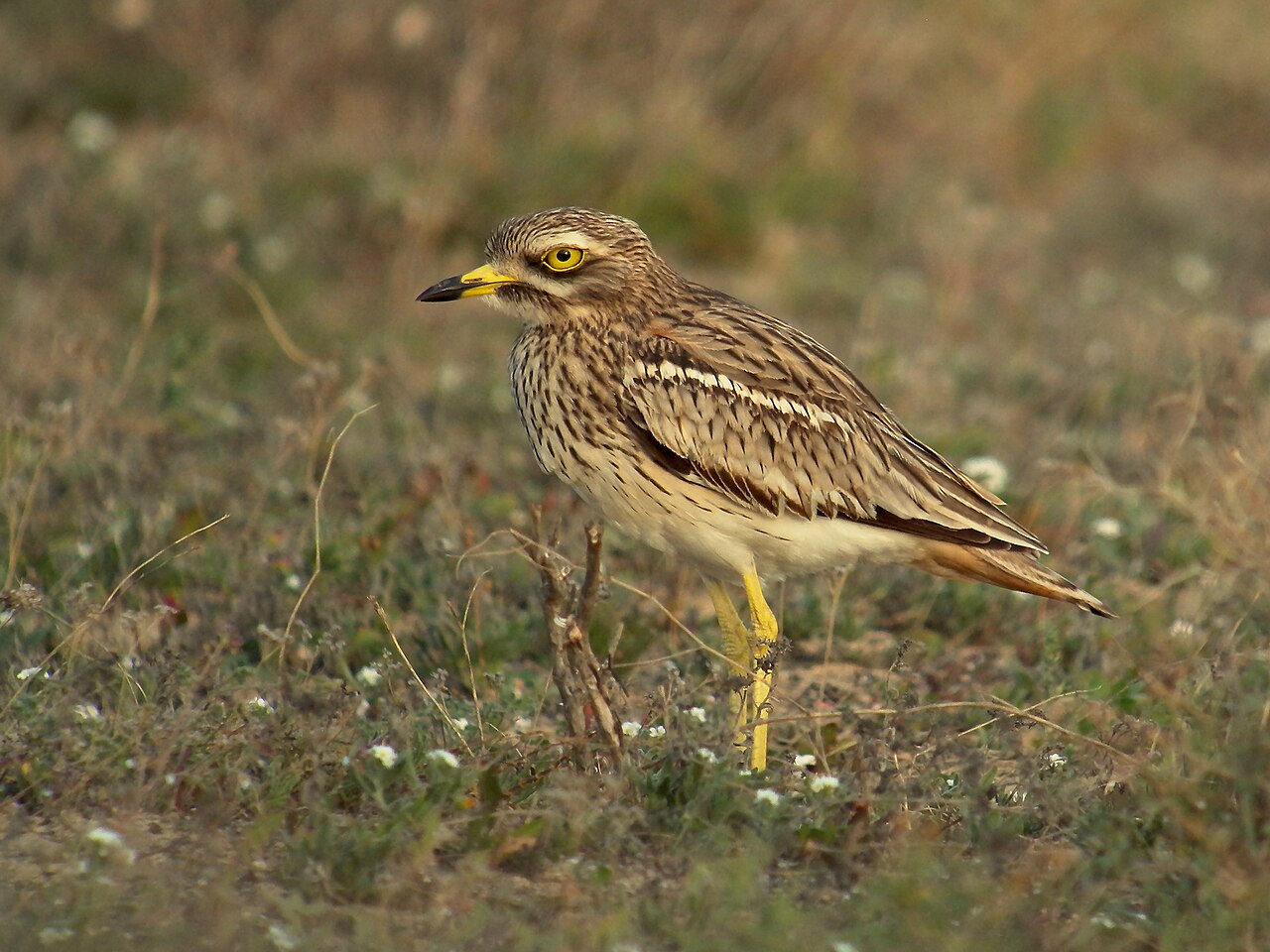
The Eurasian stone-curlew, Eurasian thick-knee, or simply stone-curlew is a northern species of the Burhinidae (stone-curlew) bird family.
Region
Western Palearctic
Typical Environment
Occurs across much of Europe, North Africa, and parts of Western and Central Asia, with northern breeders wintering in North Africa and the Middle East. Prefers dry, open habitats such as stony fields, sandy heaths, steppe grasslands, fallow farmland, and coastal dunes. It avoids dense vegetation, favoring short swards and sparsely vegetated ground where visibility is high. Daytime is spent resting or crouching, often relying on camouflage; it becomes active mainly from dusk through the night.
Altitude Range
0–1500 m
Climate Zone
Temperate
Ease of Keeping
Beginner friendly: 1/5
Also called the Eurasian thick-knee, it is a mostly nocturnal wader adapted to dry, open ground rather than wetlands. Its large yellow eyes help it forage at night and give it a striking appearance. The species nests on bare ground where its mottled plumage and eggs are extremely well camouflaged.


Eggs in the Museum Wiesbaden collection
Temperament
wary and mostly nocturnal
Flight Pattern
strong, direct flight with rapid wingbeats; conspicuous white wingbars in flight
Social Behavior
Breeds in loose territories, typically as solitary pairs. Nest is a simple scrape on bare or sparsely vegetated ground, usually with two well-camouflaged eggs. Both parents incubate and tend the precocial chicks, which leave the nest soon after hatching.
Migratory Pattern
Partial migrant
Song Description
A loud, ringing, and eerie series of yelping whistles often heard at dusk and during the night. Calls carry over long distances and are most frequent in spring and early summer during territorial displays.
Plumage
Sandy-brown to grey-brown with dark streaking and mottling, providing excellent camouflage against dry ground; bold black-and-white wing pattern visible in flight.
Diet
Primarily feeds on insects such as beetles, grasshoppers, earwigs, and moths, taken from the ground. Also consumes earthworms and other invertebrates. Will opportunistically take small reptiles, amphibians, or small rodents when available.
Preferred Environment
Forages on open, sparsely vegetated ground including stony fields, grazed grassland, dry steppe, and coastal dunes. Often hunts along field margins and lightly cultivated land where prey is abundant and cover is low.


