The Eurasian sparrowhawk, also known as the northern sparrowhawk or simply the sparrowhawk, is a small bird of prey in the family Accipitridae. Adult male Eurasian sparrowhawks have bluish grey upperparts and orange-barred underparts; females and juveniles are brown above with brown barring below. The female is up to 25% larger than the male – one of the greatest size differences between the sexes in any bird species. Though it is a predator which specialises in catching woodland birds, the Eurasian sparrowhawk can be found in any habitat and often hunts garden birds in towns and cities. Males tend to take smaller birds, including tits, finches and sparrows; females catch primarily thrushes and starlings but are capable of killing birds weighing 500 g (18 oz) or more.
Region
Europe and temperate Asia
Typical Environment
Found across much of the Palearctic from the British Isles and Scandinavia through continental Europe into temperate Asia and parts of the Middle East and North Africa. It occupies mixed and coniferous forests, woodland edges, hedgerow-dominated farmland, parks and suburban gardens. Breeding typically occurs in areas with dense cover, while hunting takes place along edges, rides, and clearings. In winter many northern birds move south into milder lowlands, river valleys, and coastal zones. It generally avoids vast treeless plains and deep, continuous forest interiors.
Altitude Range
Sea level to 3000 m
Climate Zone
Temperate
Ease of Keeping
Beginner friendly: 1/5
This small woodland hawk is exceptionally agile, using short, rapid bursts of flight to weave through trees and ambush birds. Females are up to a quarter larger than males, allowing the sexes to target different prey sizes and reduce competition. It often hunts in suburban gardens, contributing to its familiarity across much of Europe.


Claws of Eurasian sparrowhawk

The resemblance of the common cuckoo (Cuculus canorus) to the Eurasian sparrowhawk helps it avoid aggression from the small birds whose nest it seeks to parasitise.

Deciduous woodland is a typical breeding and hunting habitat for the Eurasian sparrowhawk.
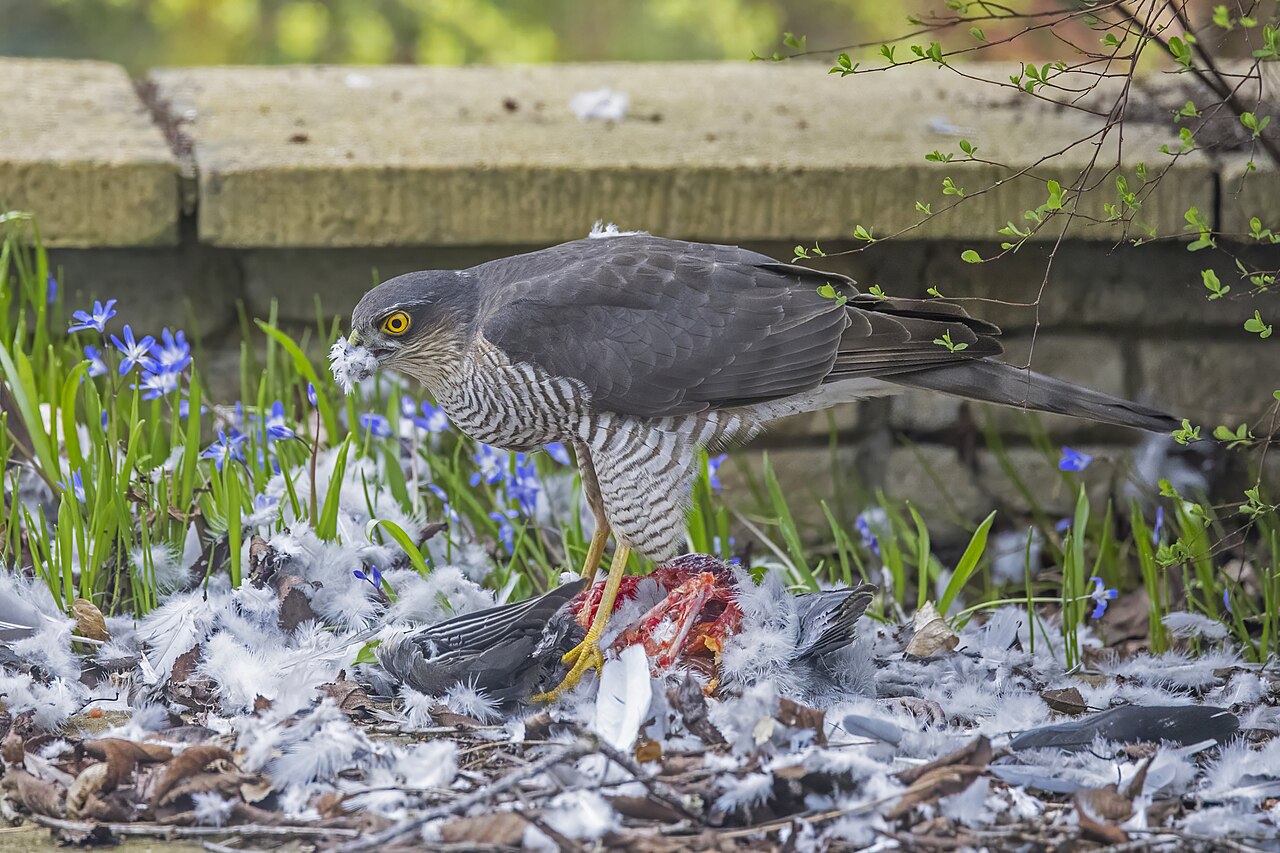
Adult male eating a pigeon

A juvenile with the carcass of a common wood pigeon (Columba palumbus)

With common starling prey
![Illustration of an egg. The background colour of the eggs changes from light blue to white on storage in collections[52]](https://upload.wikimedia.org/wikipedia/commons/thumb/3/39/Accipiter_nisus_MHNT.jpg/1280px-Accipiter_nisus_MHNT.jpg)
Illustration of an egg. The background colour of the eggs changes from light blue to white on storage in collections[52]

The chicks stay on the nest until they are 24 to 28 days old.

In flight as seen from below, showing barring on underparts.

The Eurasian sparrowhawk's natural hunting behaviour can conflict with gamekeepers rearing common pheasants.

The Eurasian sparrowhawk is popular with falconers in Georgia.

An adult male in Slovakia
Temperament
solitary and territorial
Flight Pattern
short rapid wingbeats interspersed with brief glides
Social Behavior
Generally solitary outside the breeding season. Pairs form in spring and nest in trees, building a stick platform often reused or refurbished annually. Clutches typically contain 3–6 eggs; the female incubates while the male provides most food early in the nesting period.
Migratory Pattern
Partial migrant
Song Description
Vocalizations include a rapid, high-pitched kik-kik-kik alarm or contact call, especially around the nest. Adults may give sharp, repeated kek notes during territorial displays or when disturbed. Calls are brief and piercing rather than melodious.
Plumage
Males have blue‑grey upperparts with rich orange barring on the underparts; females and juveniles are brown above with brownish barring below. Both sexes show a long, banded tail and short, rounded wings adapted for maneuvering through woodland. Fine barring continues onto the throat and flanks.
Diet
Primarily hunts small to medium-sized birds, from tits and sparrows to thrushes and starlings; females can take larger prey than males. It occasionally takes small mammals, bats, and large insects when available. Ambush tactics include surprise dashes from cover, low contour-hugging flight, and short pursuits through vegetation. Prey is plucked at regular plucking posts.
Preferred Environment
Hunts along woodland edges, hedgerows, gardens, and clearings where cover meets open space. Frequently uses concealed perches to watch and launch surprise attacks, and will exploit bird feeders in suburban areas. Nests are placed within dense foliage of conifers or broadleaf trees.