
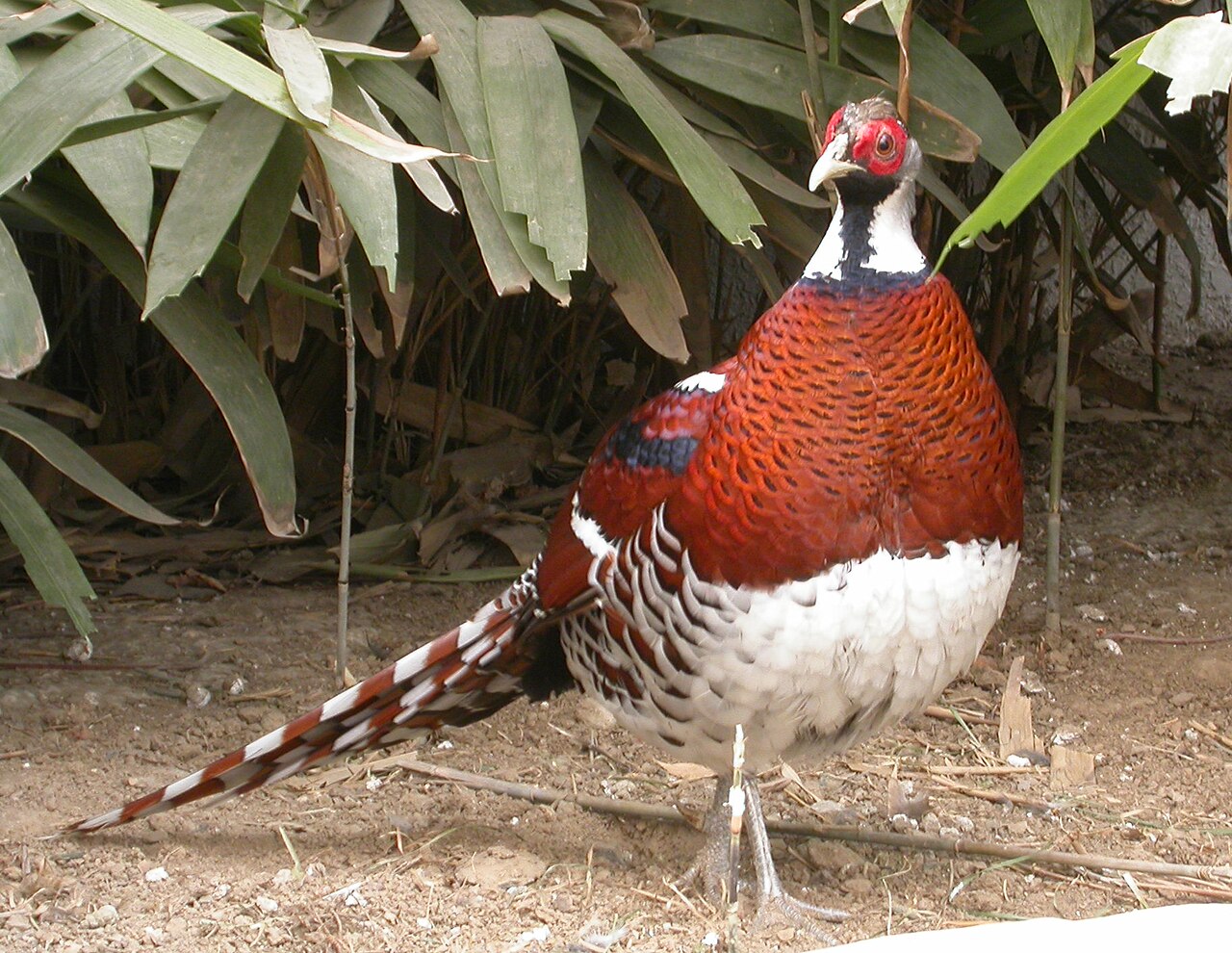
Elliot's pheasant is a large pheasant native to south-eastern China.
Region
Southeast China
Typical Environment
Found in subtropical evergreen and mixed broadleaf forests with dense understory, often where bamboo, laurels, and rhododendrons are common. It frequents steep slopes, ravines, and forest edge mosaics but remains close to thick cover. The species spends most of its time on the forest floor, using leaf litter for foraging and concealment. It avoids heavily disturbed areas, persisting best in large, connected forest blocks.
Altitude Range
200–1900 m
Climate Zone
Subtropical
Ease of Keeping
Beginner friendly: 2/5
Elliot's pheasant is a shy, ground-dwelling forest bird endemic to southeastern China and named after American naturalist Daniel Giraud Elliot. Males show a striking white wing patch and a long, boldly barred tail used in displays. The species is threatened by habitat loss and fragmentation, and persists mainly in protected or remote forest tracts. It prefers dense, subtropical evergreen forests with bamboo and rhododendron understory.

Temperament
shy and secretive
Flight Pattern
short rapid wingbeats; explosive flush
Social Behavior
Mostly terrestrial, foraging alone, in pairs, or in small family groups. During the breeding season, males display with tail fanning, wing-whirring, and posturing to attract females. Nests are shallow scrapes on the ground in dense cover; clutches are typically several pale eggs. Parental care is primarily by the female.
Migratory Pattern
Resident
Song Description
Vocalizations include low, resonant hoots and short cackling calls, especially at dawn and dusk. Males also produce a rapid wing-whirr during display flights that carries through the forest.
Plumage
Male shows rich rufous-chestnut body with a contrasting white wing patch edged in black, greyish head and neck, white throat and lower breast, and a very long, boldly barred tail. Female is smaller and mottled brown with fine barring and spotting, a shorter, barred tail, and a paler throat.
Diet
It feeds on seeds, fallen fruits and berries, tender shoots and leaves, and a variety of invertebrates such as beetles, ants, termites, and worms. Foraging consists of scratching and probing through leaf litter on the forest floor. Seasonal availability of fruits and insects influences diet composition.
Preferred Environment
Forages under dense understory in broadleaf evergreen forests, along bamboo thickets, and at forest edges near clearings or streams. It stays close to cover, moving quietly along trails and among shrubs.


