

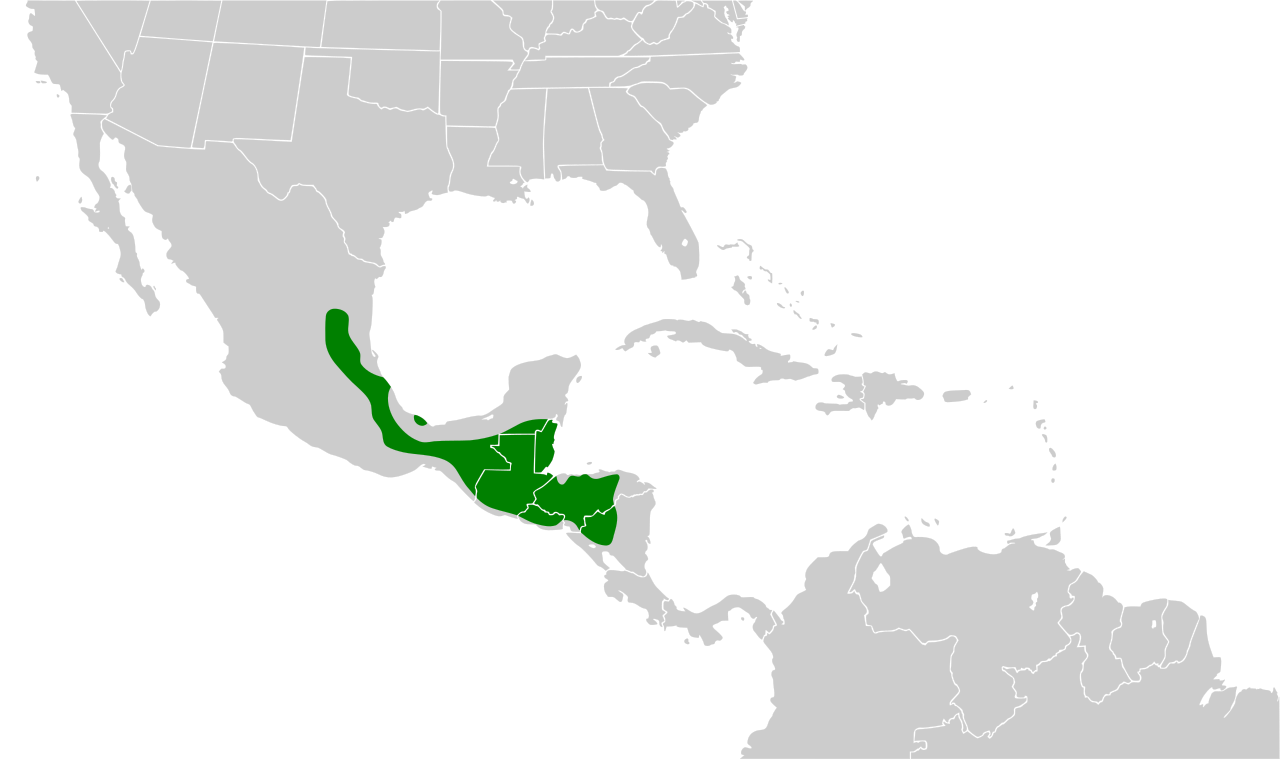
The emerald toucanet is a species of near-passerine bird in the toucan family Ramphastidae. It is found from Mexico to Nicaragua.
Region
Mesoamerica (southern Mexico to Nicaragua)
Typical Environment
Occupies humid montane and cloud forests, forest edges, and mature secondary growth. Frequently uses forested ravines, shade-coffee plantations, and fruiting trees near clearings. It forages mainly in the mid to upper canopy but will descend to lower strata when fruit is abundant. Occurs patchily where continuous tree cover and fruit resources persist.
Altitude Range
600–3200 m
Climate Zone
Highland
Ease of Keeping
Beginner friendly: 2/5
The emerald toucanet is a small toucan of humid highland forests, often heard before it is seen thanks to its repetitive, frog-like calls. It nests in natural cavities or old woodpecker holes, where both parents share incubation and chick-rearing. Highly frugivorous, it also eats insects and small vertebrates, playing a role in seed dispersal across montane forests.


At Belize Zoo (nominate group)

Emerald Toucanet, near Cinchona, Costa Rica, 17 March 2024.


In captivity eating a grape(nominate group)
Temperament
shy and canopy-dwelling
Flight Pattern
short undulating flights between canopy gaps
Social Behavior
Usually seen in pairs or small family groups, sometimes joining mixed-species flocks at fruiting trees. Nests in tree cavities; both sexes incubate and feed the young. Territorial calls are given from prominent perches within their home range.
Migratory Pattern
Resident
Song Description
Vocalizations are a series of hollow, croaking notes, often rendered as repeated rrrek or rrrah phrases. Calls can carry far through cloud forest, especially at dawn.
Plumage
Compact toucanet with uniformly emerald-green body, softer green crown, and chestnut-rufous tail tips.
Diet
Primarily eats a wide variety of fruits, particularly figs and other soft, lipid-rich berries. Supplements its diet with insects such as beetles, wasps, and caterpillars. Will take small vertebrates, eggs, and nestlings opportunistically. Plays an important role in seed dispersal by swallowing fruits whole and passing viable seeds.
Preferred Environment
Feeds mostly in the mid to upper canopy, visiting fruiting trees along forest edges and gaps. Also forages along vine tangles and epiphyte-laden branches within cloud forest. Occasionally descends to lower levels to exploit accessible fruit crops.


