

The dusky moorhen is a bird species in the rail family and is one of the eight extant species in the moorhen genus. It occurs in India, Australia, New Guinea, Borneo and Indonesia. It is often confused with the purple swamphen and the Eurasian coot due to similar appearance and overlapping distributions. They often live alongside birds in the same genus, such as the Tasmanian nativehen and the common moorhen.
Region
Australasia and Southeast Asia
Typical Environment
Found from India through Indonesia and Borneo to New Guinea and across much of Australia. Prefers freshwater habitats such as marshes, lakes, ponds, slow rivers, and man-made wetlands. Common in urban parks and farm dams where emergent vegetation like reeds and sedges provides cover. Tolerates some brackish water and uses floating and marginal vegetation for feeding and nesting. Nests are typically platforms of reeds or grasses anchored in dense cover.
Altitude Range
Sea level to 2000 m
Climate Zone
Subtropical
Ease of Keeping
Beginner friendly: 2/5
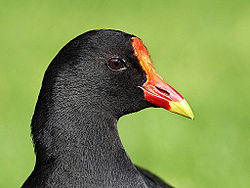
The dusky moorhen is a medium-sized rail that thrives in wetlands, urban lakes, and rice paddies. It is often confused with purple swamphens and Eurasian coots but can be told by its red frontal shield and yellow-tipped red bill, plus white undertail flashes. Dusky moorhens are adaptable and bold, frequently seen foraging on lawns near water. They build bulky reed nests and may breed cooperatively, with helpers assisting the dominant pair.




Temperament
social and active
Flight Pattern
short rapid wingbeats; reluctant flier
Social Behavior
Usually found in small groups outside the breeding season, often loosely associating with coots and swamphens. Breeding pairs are territorial, but cooperative breeding with helpers occurs. Nests are bulky platforms in dense emergent vegetation; both parents incubate and brood. Chicks are precocial and can swim shortly after hatching.
Migratory Pattern
Resident
Song Description
Vocal repertoire includes sharp clucks, grunts, and loud nasal squawks. Alarm calls are harsh and repeated, while contact calls are softer, conversational notes. Displays are often accompanied by tail-flicking and wing-posturing.
Plumage
Mostly dark slate-grey to sooty-brown with slightly paler underparts and a narrow white line along the flanks; white undertail feathers often flicked to reveal flashes. Wings can show a faint chestnut tinge. Feathers are smooth and water-shedding.
Diet
Eats aquatic plants, seeds, algae, and tender shoots, supplemented with insects, snails, worms, and occasionally small fish or tadpoles. Will graze on lawns and dabble or upend in shallow water. Opportunistic around humans, sometimes taking food scraps in parks.
Preferred Environment
Forages along vegetated margins of ponds, lakes, and slow streams, and over floating mats of vegetation. Often feeds on exposed mud or short grass near water, retreating to cover when disturbed.


