

The Cuban blackbird is a species of bird in the family Icteridae.
Region
Greater Antilles
Typical Environment
Endemic to Cuba, occurring across much of the main island and on Isla de la Juventud. It favors open and semi-open habitats such as forest edges, scrub, savannas, plantations, and mangroves. The species adapts well to human-modified landscapes, including gardens, parks, and agricultural fields. It generally avoids dense interior forest but uses edges, clearings, and secondary growth.
Altitude Range
Sea level to 1200 m
Climate Zone
Tropical
Ease of Keeping
Beginner friendly: 1/5
The Cuban blackbird is an icterid endemic to Cuba, easily recognized by its uniformly glossy black plumage with a subtle violet sheen. It frequents forest edges, farmland, and towns, often foraging boldly on the ground. Compared with the larger Greater Antillean grackle, it has a shorter tail and a heavier, straighter bill. Its calls are nasal and buzzy, with chatters and squeaks delivered from exposed perches.


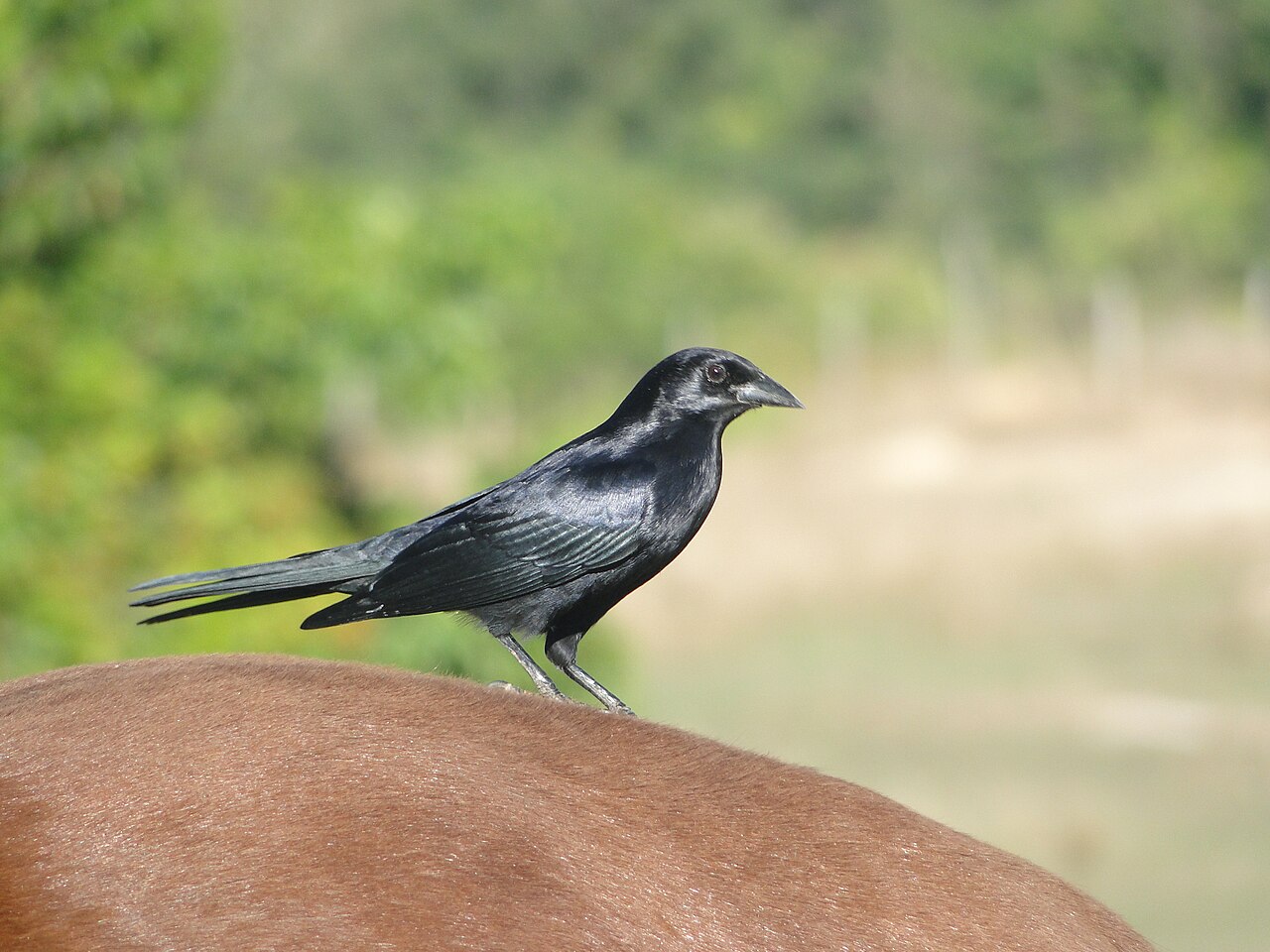
A Cuban blackbird in Pinar del Rio Province
Temperament
social and active
Flight Pattern
short rapid wingbeats
Social Behavior
Often seen in small groups, especially at feeding sites and communal roosts. Pairs defend a nesting area during the breeding season, building cup nests in trees or tall shrubs. They readily exploit human-altered habitats and can be confiding around settlements.
Migratory Pattern
Resident
Song Description
Vocalizations include harsh, nasal chatters and buzzes interspersed with squeaky notes. Males deliver simple phrases from exposed perches; calls carry well in open country.
Plumage
Uniformly glossy black with a subtle purple-violet sheen; sleek, smooth feathers.
Diet
Omnivorous, taking insects and other arthropods, small snails, and a variety of fruits and seeds. It also gleans scraps and grain around human habitation and farms. Foraging is primarily on the ground and low vegetation, with probing and gleaning typical.
Preferred Environment
Feeds in open fields, pasture edges, plantations, and village streets, as well as along mangroves and forest margins. Often associates with livestock and human activity where food is abundant.


