
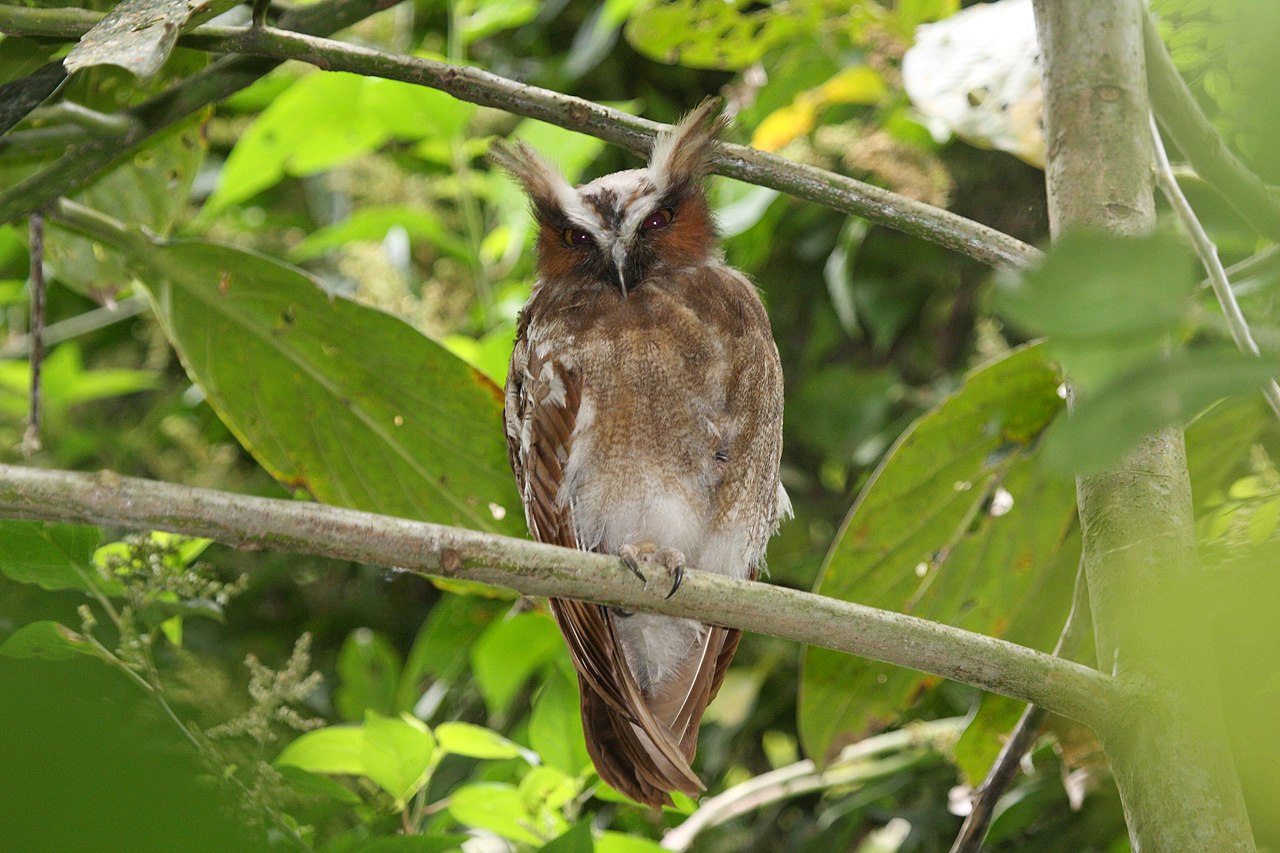
The crested owl is a species of owl in the family Strigidae. It is the only species (monotypic) in the genus Lophostrix. It is a resident bird and occurs in Central America and northern South America. It is a medium-sized owl, easily recognizable with its very long whitish ear tufts and otherwise darker appearance. It inhabits lowland rainforests and prefers old growth in proximity with water. The crested owl is a strictly nocturnal species, but very little is known about its behaviour.
Region
Neotropics (Central America to northern South America)
Typical Environment
Found from southern Mexico and Central America through Colombia, Venezuela, and the Guianas into northern Amazonia. It favors primary lowland rainforest with dense understory and prefers areas near streams or swampy tracts. The species mainly occupies the forest interior, roosting by day in vine tangles or dense foliage. It can occur in mature secondary forest and along quiet forest edges but is far less common there.
Altitude Range
Sea level to 1200 m
Climate Zone
Tropical
Ease of Keeping
Beginner friendly: 1/5
This is the only species in the genus Lophostrix and is notable for its extremely long, whitish ear tufts that give it a striking silhouette. It keeps to the deep interior of lowland rainforests and is often detected by voice rather than sight. Despite being widespread in the Neotropics, its secretive habits mean many aspects of its ecology remain poorly known.


Temperament
solitary and secretive
Flight Pattern
short rapid wingbeats with silent, low glides
Social Behavior
Typically solitary outside the breeding season and strongly tied to dense forest cover. Nests are believed to be in tree cavities or similar sheltered sites, with minimal nest material. Clutches are small (often 1–2 eggs), with the female incubating while the male provides food.
Migratory Pattern
Resident
Song Description
Gives deep, resonant hoots and gruff, growling notes delivered in spaced sequences at night. Calls carry well through humid forest and are often the first sign of its presence, especially near streams.
Plumage
Overall dark chocolate-brown to rufous-brown with a contrasting pale facial disk bordered darker; very long, whitish ear tufts are prominent. Underparts are dusky with subtle mottling or barring. Tarsi are feathered; flight feathers and tail show faint darker bars.
Diet
Hunts mainly large arthropods such as katydids, beetles, and cicadas, supplemented by small vertebrates including rodents, small birds, frogs, and lizards. It uses low to mid-level perches to scan and then drop-pounces on prey. Prey is swallowed whole or torn apart with the hooked bill.
Preferred Environment
Feeds within the dark interior of primary rainforest, often along watercourses and in areas with dense understory. Occasionally forages along quiet forest edges or in mature secondary growth.


