
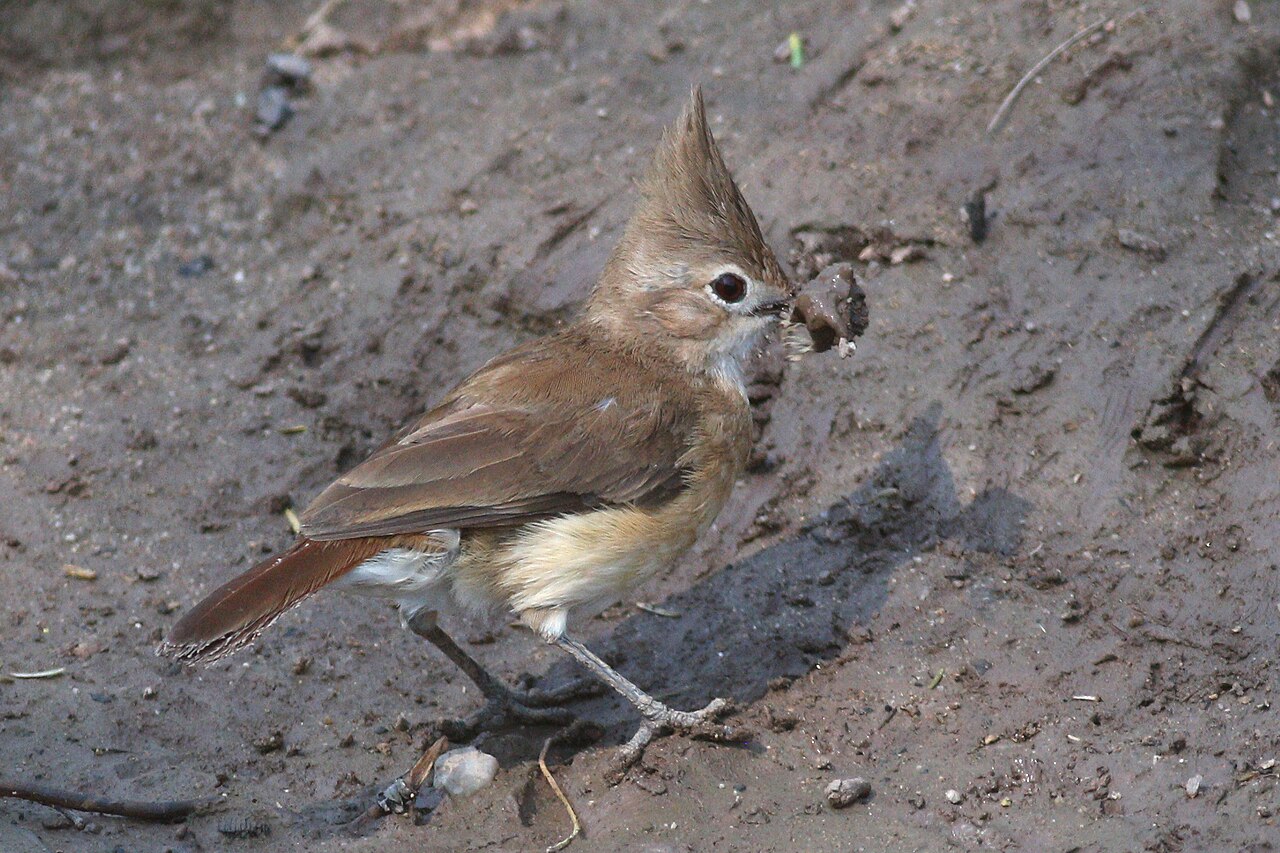
The crested hornero is a species of bird in the Furnariinae subfamily of the ovenbird family Furnariidae. It is found in Argentina, Bolivia, and Paraguay.
Region
Gran Chaco
Typical Environment
Occurs across the dry Chaco of northern Argentina, western Paraguay, and southeastern Bolivia. It favors open thorn scrub, quebracho woodlands, and savanna-like pastures with scattered trees. The species adapts well to human-modified ranchlands and roadside groves, using posts and utility structures for nesting. It avoids dense, humid forests and very open treeless plains but is common in ecotones and edges.
Altitude Range
0–1200 m
Climate Zone
Subtropical
Ease of Keeping
Beginner friendly: 1/5
The crested hornero is an ovenbird famed for building sturdy, oven-shaped mud nests with a side entrance, often on tree branches or fence posts. Its Spanish name 'hornero' means 'baker,' a nod to these kiln-like nests. Pairs are strongly territorial and perform loud duets, often with the crest raised during displays. It thrives in the semi-arid Gran Chaco where thorny scrub and open woodlands dominate.


Temperament
solitary and territorial
Flight Pattern
short rapid wingbeats, low and undulating
Social Behavior
Typically found in pairs that maintain year-round territories. Both sexes construct the mud 'oven' nest and share incubation and chick rearing. Nests are often placed on exposed branches, fence posts, or man-made structures, and territories are defended with displays and raised crest.
Migratory Pattern
Resident
Song Description
A loud, rattling duet with accelerating, chattering notes delivered by both sexes, often from exposed perches. Calls include sharp chips and trills used in territorial interactions. Duets are synchronized and can carry over long distances in open habitats.
Plumage
Warm rufous-brown upperparts with paler, buffy underparts and a slightly streaked throat; wings and tail rich rufous. An erectile crest on the crown gives a peaked profile. Texture is plain with minimal patterning aside from facial contrasts.
Diet
Primarily takes ground-dwelling arthropods such as beetles, ants, termites, and spiders. Forages by walking and probing soil, litter, and crevices around roots and fallen branches. May occasionally take small larvae or other invertebrates disturbed by grazing livestock.
Preferred Environment
Feeds in open scrub, woodland edges, and pasturelands with scattered shrubs and trees. Often forages along paths, fence lines, and near the base of bushes where leaf litter accumulates.


