

The common shelduck is a waterfowl species of the shelduck genus, Tadorna. It is widespread and common in the Euro-Siberian region of the Palearctic, mainly breeding in temperate and wintering in subtropical regions; in winter, it can also be found in the Maghreb.
Region
Euro-Siberian Palearctic
Typical Environment
Breeds from the British Isles across northern and central Europe into western and central Asia. Favors coastal estuaries, mudflats, saltmarshes, and brackish lagoons, but also uses large inland lakes and steppe wetlands. In winter it concentrates on ice-free coasts around the North Sea, Atlantic, Mediterranean, and Black Sea, and into the Maghreb. Outside breeding, it forms dense flocks on broad tidal flats where food is abundant. It avoids densely forested areas and steep, high-altitude terrain.
Altitude Range
Sea level to 1500 m
Climate Zone
Temperate
Ease of Keeping
Beginner friendly: 2/5
The Common Shelduck is a striking, goose-sized duck of coasts and open wetlands, readily recognized by its bold white, black, and chestnut patterning. It often nests in burrows or rabbit warrens some distance from water and forms large post-breeding moulting flocks. Pairs are typically long-term, and broods sometimes gather into crèches cared for by multiple adults. It is widespread across the Euro-Siberian Palearctic, breeding mainly in temperate zones and wintering farther south into subtropical coasts.




Temperament
social and active
Flight Pattern
strong flier with direct flight and rapid wingbeats
Social Behavior
Typically forms long-term pairs that nest in burrows, rabbit warrens, or cavities, often some distance from water. Clutches are relatively large, and families may join together into crèches for collective defense. Outside breeding, it gathers in large flocks, especially at moulting and on rich feeding flats.
Migratory Pattern
Partial migrant
Song Description
Generally quiet; the male gives a wheezy whistling call, especially in display. Females utter deeper honks and nasal calls, with hisses and grunts in threat situations.
Plumage
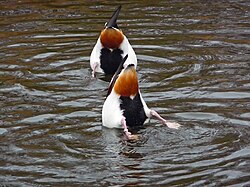
Glossy dark green head with a mostly white body, a rich chestnut breast band, and black mantle and flight feathers; bold white wing panels visible in flight.
Diet
Feeds mainly on small aquatic invertebrates such as snails (including mud snails), crustaceans, insects, and polychaete worms. Also takes seeds, algae, and other plant material, especially in inland habitats. Forages by dabbling, sieving surface films, and probing soft mud on exposed flats. Young birds focus heavily on minute invertebrates for rapid growth.
Preferred Environment
Most often feeds on intertidal mudflats, sandflats, and shallow brackish lagoons where tidal cycles expose prey. Inland, it grazes and dabbles along lake margins, flooded meadows, and saline steppe lakes.


