

The common raven or northern raven is a large all-black passerine bird. It is the most widely distributed of all corvids, found across the Northern Hemisphere. There are 11 accepted subspecies with little variation in appearance, although recent research has demonstrated significant genetic differences among populations from various regions. It is one of the two largest corvids, alongside the thick-billed raven, and is the heaviest passerine bird; at maturity, the common raven averages 63 centimetres in length and 1.47 kilograms in weight, up to 2 kg (4.4 lb) in the heaviest individuals. Although their typical lifespan is considerably shorter, common ravens can live more than 23 years in the wild. Young birds may travel in flocks but later mate for life, with each mated pair defending a territory.
Region
Northern Hemisphere
Typical Environment
The common raven occupies a vast Holarctic range, from coastal cliffs and boreal forests to deserts, tundra, and mountainous regions. It adapts readily to human-altered landscapes, including farmlands, towns, and landfills. Cliff faces, tall trees, and structures provide nest sites, while open areas and shorelines offer foraging opportunities. In the far north and at high elevations it remains year-round where food is available, making short seasonal movements when conditions are harsh.
Altitude Range
Sea level to 4000 m
Climate Zone
Other
Ease of Keeping
Beginner friendly: 1/5
Common ravens are among the most intelligent birds, capable of problem-solving, tool use, and complex social behaviors. They often perform aerial acrobatics and are skilled mimics, imitating other birds and even human-made sounds. Pairs typically mate for life and defend large territories year-round.


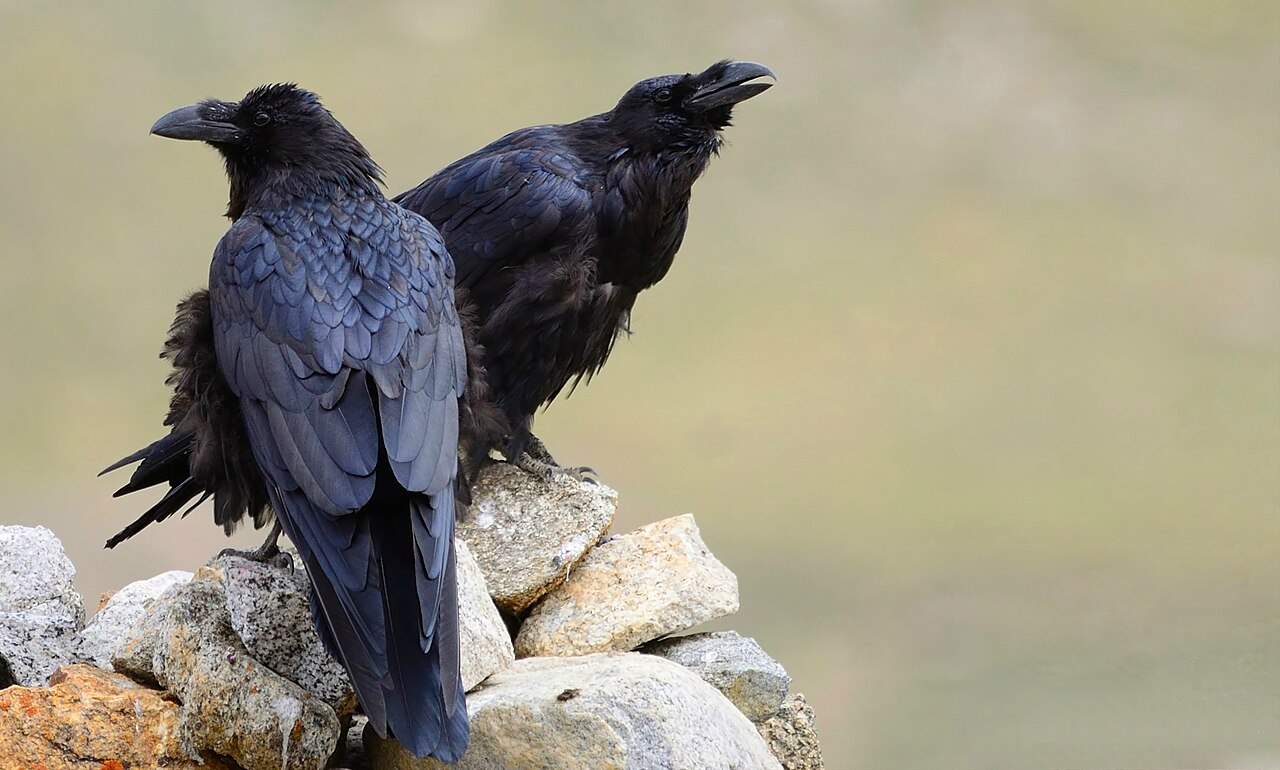


In sunlight, the plumage can display a blue or purple sheen which is a result of iridescence.

Comparison between an American crow (left) and a common raven (right)
![Leucistic. This individual is locally well known in Anchorage (Alaska).[43]](https://upload.wikimedia.org/wikipedia/commons/thumb/3/32/Common_Raven_imported_from_iNaturalist_photo_338614949_on_6_December_2024.jpg/1280px-Common_Raven_imported_from_iNaturalist_photo_338614949_on_6_December_2024.jpg)
Leucistic. This individual is locally well known in Anchorage (Alaska).[43]

Two juveniles in Iceland

Two juvenile common ravens in Palm Desert, California

Group of ravens gathered around dead member

Young on a nest – Hvítserkur, Iceland

Eggs of Corvus corax

A pair with 3–4 young on top of a high-voltage pylon in Ystad.

Feeding

Holding a deer leg

Flock feeding at a garbage dump

Dilapidated Nike Missile radar dome in Alaska with an evening roost

Specimen of the extinct pied raven, a colour morph from the Faroe Islands

Bill Reid's sculpture The Raven and the First Men, showing part of a Haida creation myth. Museum of Anthropology, University of British Columbia.

A valkyrie speaks with a raven in a 19th-century illustration of the Old Norse poem Hrafnsmál ("raven song") by Frederick Sandys
Temperament
highly intelligent, bold, and territorial in pairs
Flight Pattern
strong flier and soaring glider with deep wingbeats and agile aerial maneuvers
Social Behavior
Young birds often form loose flocks and use communal roosts, while adult pairs maintain and defend territories. Pairs usually mate for life and build large stick nests on cliffs, tall trees, or human structures. They cache surplus food and exhibit cooperative behaviors, especially among juveniles.
Migratory Pattern
Resident to partial migrant
Song Description
Vocalizations are varied, dominated by deep croaks, knocks, and guttural calls that carry over long distances. They also produce clicks, rattles, and can mimic other species and sounds in their environment.
Plumage
Entirely black with a glossy, often bluish or purplish iridescence; shaggy throat hackles are prominent.
Diet
A versatile omnivore, it feeds on carrion, small mammals, birds, eggs, insects, and other invertebrates. It readily takes berries, grains, and seeds, and often exploits human refuse. Ravens cache food in multiple sites and sometimes pirate food from other animals. They will cooperate to access difficult food sources and are adept at problem-solving while foraging.
Preferred Environment
Often feeds in open habitats such as coastal shorelines, tundra, deserts, pastures, and along roads where carrion is available. It also forages around settlements, landfills, and agricultural areas, and patrols cliffs and forest edges near nest sites.


