

The chowchilla is a passerine bird in the family Orthonychidae. It is endemic to Australia.
Region
Wet Tropics of Queensland
Typical Environment
Found in upland tropical rainforests of northeastern Queensland, especially on the Atherton Tablelands and adjacent ranges. They favor dense understory with deep leaf litter and tangles of vines, often near streams and gullies. The species is strongly tied to intact, mature rainforest and avoids open or heavily disturbed habitats. Within suitable forest, they occupy territories year-round and are typically encountered on or near the forest floor.
Altitude Range
250–1250 m
Climate Zone
Tropical
Ease of Keeping
Beginner friendly: 1/5
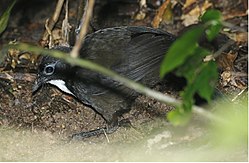
Chowchillas live in tight-knit groups that move noisily through leaf litter, often performing impressive antiphonal choruses where several birds call in sequence. They are powerful ground foragers, using strong legs to scratch and flick leaves aside in search of prey. Their striking pale eyes stand out in the dim rainforest understory, and they rarely fly far, preferring to run or hop.


Temperament
social and active
Flight Pattern
short rapid wingbeats; reluctant flier, usually low to the ground
Social Behavior
Lives in small, stable groups that maintain year-round territories. Groups forage together on the forest floor and engage in coordinated vocal displays. Nesting is usually near the ground within dense vegetation; pairs are monogamous and may be assisted by group members.
Migratory Pattern
Resident
Song Description
Loud, ringing choruses made up of overlapping phrases, often delivered antiphonally by several birds. Calls carry far through rainforest and include sharp chips, churring notes, and repeated whistles.
Plumage
Dark chocolate-brown above with warmer rufous-brown flanks and underparts; throat and upper breast show contrasting pale to buff tones with fine scalloping. Short rounded wings and a short tail emphasize its ground-dwelling build.
Diet
Primarily hunts terrestrial invertebrates such as beetles, ants, spiders, cockroaches, and worms taken from leaf litter. It occasionally takes small snails or other soft-bodied prey. Prey is located by vigorous scratching and flicking of leaves with the feet.
Preferred Environment
Feeds on the shaded rainforest floor, especially where leaf litter is deep and moist. Often works along gullies, fallen logs, and dense vine tangles that harbor abundant invertebrates.


